Commercial (A-2) vs Residential (A-1) Electricity Tariff Rates in Pakistan 2026 | BillsOnlinePk
Executive Summary: In Pakistan, the category of electricity tariff assigned to your utility meter can mean the difference between a manageable monthly utility bill and severe financial insolvency. Thousands of small business owners, home-based entrepreneurs, clinics, beauty parlors, and private schools discover with horror that their meter is billed under the punitive Commercial Tariff (Tariff A-2), where base unit rates exceed Rs. 65 to Rs. 75 per kilowatt-hour, accompanied by non-adjustable advance income taxes, maximum demand charges, and 18% General Sales Tax. Conversely, many landlords running commercial rental shops illegally power them from domestic residential meters (Tariff A-1), exposing themselves to catastrophic detection bills and criminal penalties. What are the exact differences between Commercial A-2 and Domestic A-1 tariffs? How do electricity taxes differ? How can an incorrectly categorized meter be lawfully reclassified? This 2026 legal and technical manual provides complete NEPRA tariff schedules, tax formulas, and reclassification procedures across MEPCO, LESCO, IESCO, and K-Electric.
Table of Contents (Jump to Section)
- 1. Regulatory Definitions: NEPRA Tariff A-1 (Domestic) vs Tariff A-2 (Commercial)
- 2. Rate & Tax Breakdown: The Brutal Cost Multipliers of Commercial Billing
- 3. The Advance Income Tax (Section 235) Trap: Active Taxpayer List (ATL) Benefits
- 4. Mixed-Use Building Dilemma: Commercial Ground Floor vs Domestic Upper Floors
- 5. Tariff Reclassification Roadmap: How to Convert Commercial to Domestic
- 6. Maximum Demand Indicator (MDI) & Fixed Charges on Commercial Connections
- 7. Solar Net Metering for Commercial Enterprises: Accelerating ROI
- 8. Frequently Asked Questions (FAQ)
1. Regulatory Definitions: NEPRA Tariff A-1 (Domestic) vs Tariff A-2 (Commercial)
Under NEPRA Consumer Eligibility Guidelines, electricity connections are categorized strictly based on physical premises utilization:
- Tariff A-1 (Domestic / Residential): Applies exclusively to private residences, individual apartments, domestic servants' quarters, and private residential garages where electricity is consumed purely for domestic living. Tariff A-1 features a progressive multi-slab structure: consumers consuming under 200 units consistently benefit from "Protected Consumer" status with subsidized unit rates, while consumption above 300 units steps into non-protected brackets.
- Tariff A-2 (Commercial): Applies to all commercial enterprises, retail shops, wholesale markets, shopping plazas, business offices, private clinics, beauty salons, restaurants, commercial coaching academies, banks, and storage godowns. Unlike residential tariffs, Tariff A-2 has zero lifeline subsidies. It operates with a flat, aggressive base rate regardless of whether you consume 50 units or 5,000 units!
2. Rate & Tax Breakdown: The Brutal Cost Multipliers of Commercial Billing
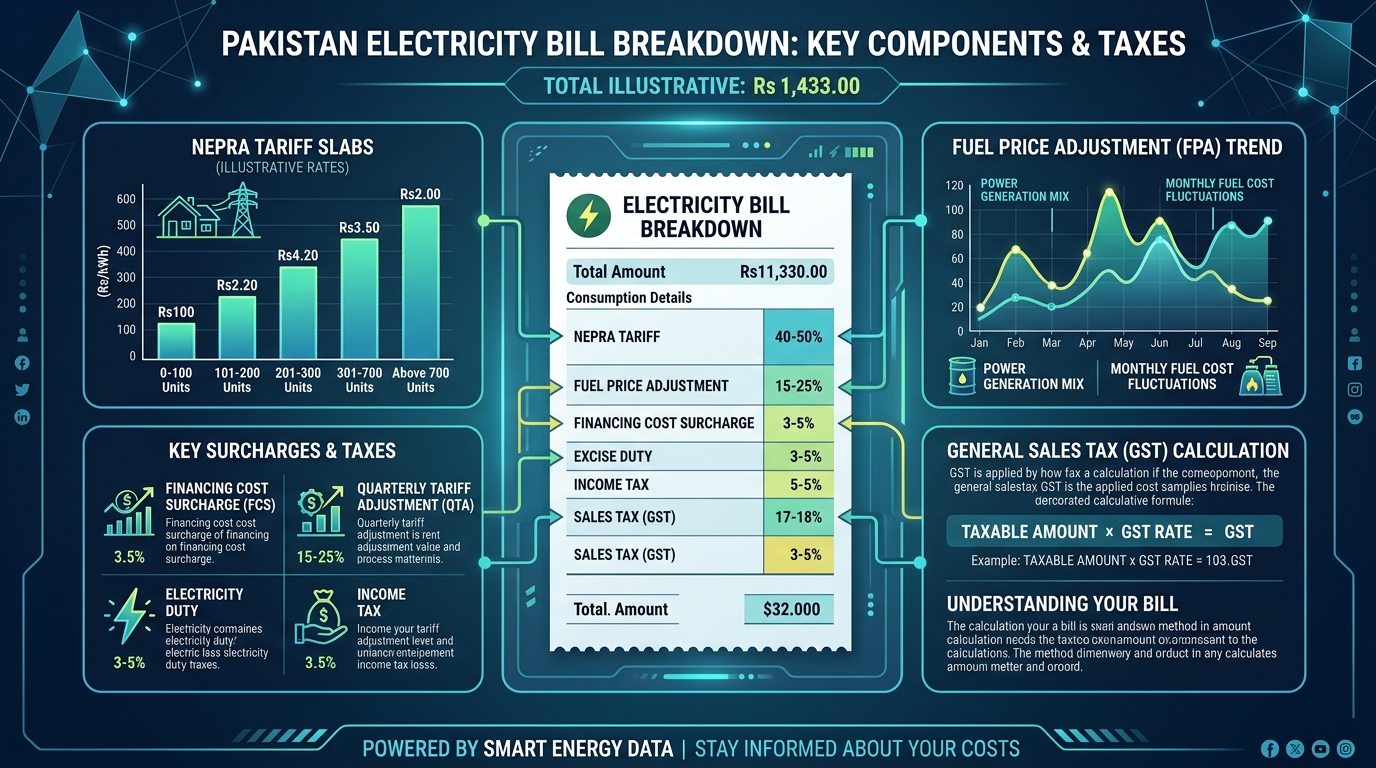
To see why commercial electricity bills are shockingly high, let us compare the itemized cost breakdown of 500 electricity units consumed under Domestic A-1 vs Commercial A-2 under 2026 tariff schedules:
| Billing Line Item | Domestic Tariff A-1 (500 Units) | Commercial Tariff A-2 (500 Units) | Financial Divergence & Commentary |
|---|---|---|---|
| Base Energy Charge | ~Rs. 42.00 / Unit (Rs. 21,000) | ~Rs. 58.50 / Unit (Rs. 29,250) | Commercial base rate is ~40% higher from Unit 1 |
| General Sales Tax (18% GST) | Applied on energy charge | Applied on energy + fixed charges | Commercial pays higher gross tax base |
| Advance Income Tax (Under Sec 235) | Rs. 0 (Exempt for non-filers <Rs. 25k) | 10% to 12% Mandatory Withholding | Major financial deduction on commercial meters |
| Further Sales Tax (FST) / Extra Tax | Not Applicable | 3% to 4% for Unregistered Entities | Penalizes commercial accounts lacking Sales Tax Registration |
| Electricity Duty & TV Fee | 1.5% ED + Rs. 35 TV Fee | 1.5% ED + Rs. 60 TV Commercial Fee | Higher flat surcharges |
| Total Estimated Invoice Amount | ~Rs. 32,500 Total | ~Rs. 49,800 Total (+53% Higher!) | Commercial consumers pay ~Rs. 17,300 MORE for the exact same units! |
3. The Advance Income Tax (Section 235) Trap: Active Taxpayer List (ATL) Benefits
For commercial consumers in Pakistan, failure to register on the Federal Board of Revenue (FBR) Active Taxpayer List (ATL) results in crushing taxation:
- Non-Filer Commercial Penalty: Under Section 235 of the Income Tax Ordinance, DISCOs are legally required to levy up to 12% Advance Withholding Tax on commercial electricity bills for individuals or businesses not appearing on the active tax filer list. On a Rs. 100,000 monthly bill, this non-filer penalty adds Rs. 12,000 in pure taxes!
- How Filers Claim Tax Adjustments: If your business is an active FBR income tax filer, the advance tax deducted on your monthly MEPCO, LESCO, or K-Electric bill is 100% adjustable against your annual corporate or personal income tax return (Form 114). Retain your monthly electricity invoices and declare the withholding tax under Code 6414 to receive full tax credits.

4. Mixed-Use Building Dilemma: Commercial Ground Floor vs Domestic Upper Floors
A widespread architectural feature across Pakistani cities is the "commercial shop on ground floor, family residence on upper floors" building. Mismanaging electricity distribution in mixed-use properties causes severe utility complications:
- The Single Commercial Meter Trap: If the entire building is powered through a single commercial meter, the family living upstairs is paying Rs. 70+ per unit for their residential fans, lights, and air conditioning! Over a year, this wastes hundreds of thousands of rupees.
- The Single Domestic Meter Danger: Conversely, if the property owner runs the ground-floor grocery store, pharmacy, or auto workshop from the residential meter, a DISCO surveillance raid will immediately classify the connection as "Unauthorized Commercial Use of Domestic Tariff." The utility will issue a massive detection bill retroactively re-billing past consumption under commercial rates with heavy 50% penalties!
- The Proper Solution: Dedicated Dual Metering: Apply on the ENC portal for two completely separate meters: a Commercial A-2 meter dedicated exclusively to the ground-floor retail shop, and an independent Domestic A-1 meter dedicated to the residential apartments above.
5. Tariff Reclassification Roadmap: How to Convert Commercial to Domestic
If a property previously used as an office or doctor's clinic has been converted back into a private family residence, you can legally change the tariff back to Domestic A-1:
- Step 1: Submit Online Change of Category Application: Visit the official ENC portal (
enc.com.pk) and select "Change of Tariff Category." - Step 2: Upload Property & Residential Proof: Provide property ownership documents, CNIC of the resident owner, an affidavit affirming purely residential use, and a site photograph showing residential living spaces (kitchen, bedrooms) rather than commercial display racks.
- Step 3: SDO Field Inspection: The Sub-Divisional Officer (SDO) or Line Superintendent visits the premises to physically verify that zero commercial or business activities are being conducted.
- Step 4: Billing Category Update: Upon SDO approval, the billing category code is changed in the computer database from A-2 to A-1, reflecting on the next monthly billing statement.
6. Maximum Demand Indicator (MDI) & Fixed Charges on Commercial Connections
For commercial installations with sanctioned loads exceeding 5kW (under Tariff A-2(b)), billing incorporates Fixed Sanctioned Load Charges:
- Fixed Charges per kW: Commercial connections pay a mandatory monthly fixed charge (typically Rs. 400 to Rs. 600 per kilowatt of sanctioned load or 50% of Maximum Demand), even if the shop is closed and consumes zero electricity units during the month!
- MDI Penalties: If your simultaneous appliance peak load exceeds your sanctioned load rating, the digital meter's MDI register logs an over-demand event, triggering automatic demand penalty surcharges on your bill.
7. Solar Net Metering for Commercial Enterprises: Accelerating ROI
Because commercial electricity tariffs are significantly higher than domestic tariffs, commercial solar net metering delivers the fastest return on investment in the renewable energy sector:
- 2-Year Payback Economics: While a residential solar system achieves financial payback in 3.0 to 3.5 years, a commercial rooftop solar array offsetting Rs. 70/unit grid electricity recovers its entire hardware investment in just 22 to 26 months! Every kilowatt-hour generated saves high-tier commercial energy charges, sales tax, and fuel price adjustments simultaneously.
8. Commercial Plaza Sub-Distribution: Avoiding Over-Slab Aggregation
In high-density commercial shopping plazas across Karachi Saddar, Lahore Gulberg, and Rawalpindi Saddar, dozens of independent retail kiosks and small boutiques frequently operate behind a single shared commercial bulk meter. Under progressive commercial demand scales and fuel adjustment multiplier tiers, aggregating 30 shops onto one meter pushes total consumption past 15,000 units monthly.
This massive volume triggers the highest tier of NEPRA commercial tariffs and maximum advance tax brackets. Plaza management committees should evaluate transitioning to independent individual retail sub-connections. By providing each commercial tenant with their own dedicated official DISCO meter, individual load remains manageable, disputes over HVAC sharing are eliminated, and commercial tenants who are active tax filers can directly claim their advance tax withholding deductions on FBR portal returns.
8. Frequently Asked Questions (FAQ)
What is the price difference between commercial and domestic electricity in Pakistan?
Commercial electricity (Tariff A-2) costs approximately 40% to 55% more than domestic residential electricity (Tariff A-1) due to higher base unit rates, mandatory advance income tax (up to 12%), and fixed commercial load surcharges.
Can I run a small shop or clinic on a domestic residential meter?
No. Running a commercial business on a domestic meter violates NEPRA regulations. If caught during an inspection raid, the DISCO will issue a heavy detection bill re-billing past units at commercial rates with penalties.
How can I change my electricity meter from commercial to domestic?
Submit an online Change of Category application on the official ENC portal (enc.com.pk) with property documents, site photos, and an affidavit. An SDO site inspection will verify purely residential use and approve the category change.
Are commercial electricity bills subject to Advance Income Tax?
Yes. Under Section 235 of the Income Tax Ordinance, commercial meters are subject to 10% to 12% advance withholding tax. If you are an active FBR tax filer, this tax is 100% adjustable against your annual tax returns.
Need to check or calculate your current utility bill?
Verify your electricity duplicate bill with instant photo-reading verification or calculate slab costs accurately.