Deep Freezer vs Refrigerator Power Consumption in Pakistan 2026: Inverter Compressor, Units & Sizing Guide | BillsOnlinePk
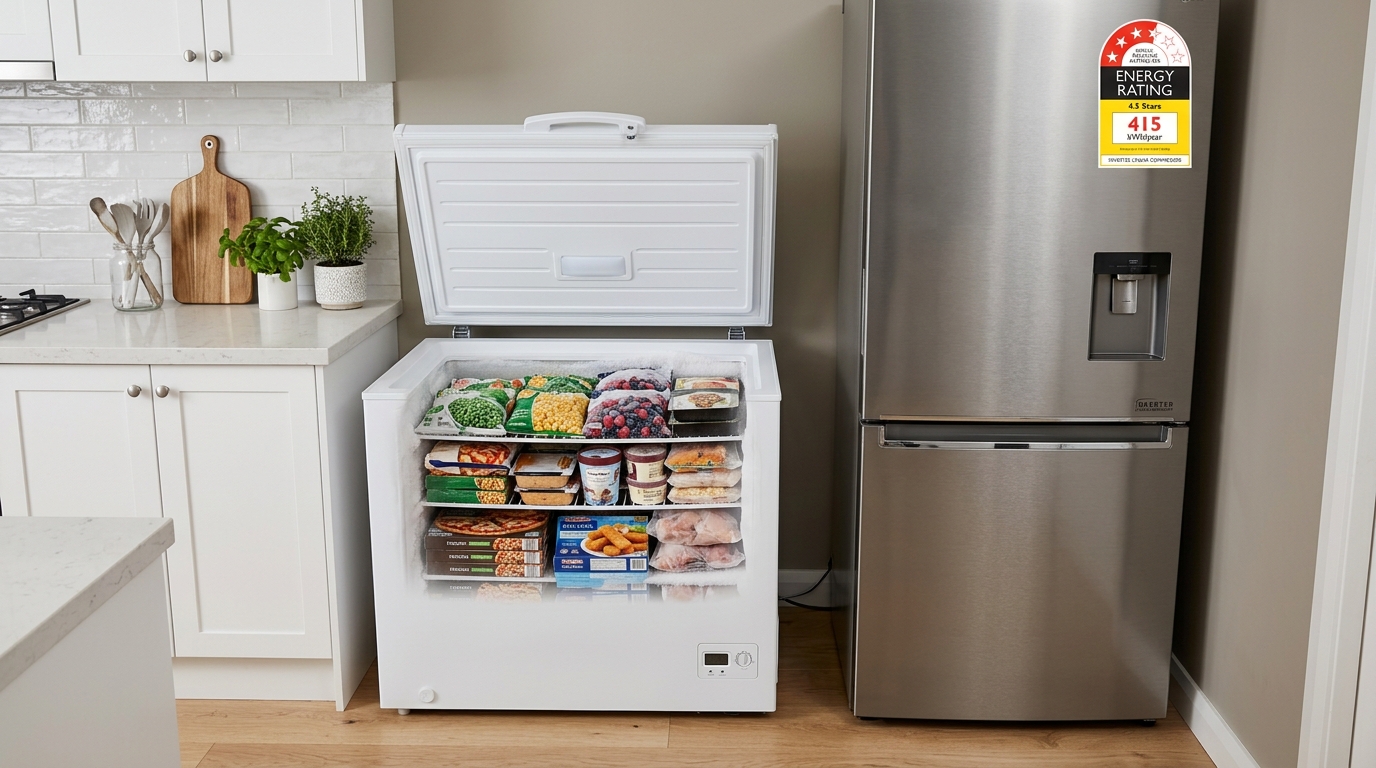
Executive Summary: In the blistering heat of Pakistani summers—where ambient outdoor temperatures routinely hover between 42°C and 49°C across Punjab, Sindh, and Khyber Pakhtunkhwa—refrigeration appliances operate continuously around the clock. In most middle-class homes, running a combination of a primary double-door refrigerator and a secondary chest deep freezer accounts for 35% to 50% of the entire baseline electricity bill outside of air conditioning. Furthermore, during Eid-ul-Adha and wedding seasons, chest freezers are packed to maximum capacity, running compressors non-stop. Understanding the thermodynamic differences between chest deep freezers and vertical refrigerators, the true savings of BLDC inverter compressors, and proper temperature calibration can save Pakistani households tens of thousands of rupees annually.
Table of Contents (Jump to Section)
- 1. Compressor Technology: Fixed-Speed Reciprocating vs Variable-Speed BLDC Inverter
- 2. Thermodynamic Differences: Chest Deep Freezer vs Vertical Refrigerator
- 3. Monthly Unit Consumption & Electricity Cost Breakdown
- 4. Bakra Eid & Summer Overloading: The Cost of Improper Freezing
- 5. Door Gasket Testing & Dust Condenser Maintenance
- 6. Solar Inverter & Low-Voltage Starting Protections
- 7. Frequently Asked Questions (FAQ)
1. Compressor Technology: Fixed-Speed Reciprocating vs Variable-Speed BLDC Inverter
The single most important component governing power consumption in refrigeration is the compressor motor:
- Non-Inverter Reciprocating Compressors (Legacy Refrigerators & Freezers): Traditional compressors operate on a crude binary principle: they are either running at 100% full speed (typically 2,850 RPM) or completely shut off. When the internal thermostat detects warming, the compressor kicks on with a massive starting surge current (6x to 8x rated current, pulling 800W to 1,200W momentarily), causing room lights to dim. Once running, it draws 180W to 280W continuously until the target temperature is reached, then shuts down. This repetitive cycling wastes immense energy through thermal overshoot and mechanical startup inertia.
- Variable-Speed BLDC Inverter Compressors (Modern Inverter Models): Inverter compressors utilize Brushless DC motors controlled by an electronic inverter drive module. Rather than shutting off completely, the compressor modulates its speed continuously between 1,000 RPM and 4,500 RPM to precisely match cooling demand. Once the internal compartment reaches set temperature, the compressor throttles down to ultra-low speeds, drawing as little as 45W to 70W of electrical power. There is zero startup surge current, resulting in 40% to 55% lower electricity consumption over non-inverter models.
2. Thermodynamic Differences: Chest Deep Freezer vs Vertical Refrigerator
Why do chest deep freezers consume less electricity per cubic foot of frozen volume than upright vertical freezers? The answer lies in basic fluid mechanics and thermal buoyancy:
- Cold Air Retention in Chest Freezers: Cold air is substantially denser and heavier than warm air. When you open the top lid of a horizontal chest deep freezer, the heavy cold air remains settled at the bottom of the insulated tub like water in a bathtub. Only a minuscule fraction of cold air spills out.
- Cold Air Spill in Vertical Refrigerators: When you open the vertical front door of a refrigerator or upright freezer, gravity causes the dense column of cold air to tumble out onto the floor instantly, replaced by warm, humid room air. Every time family members open the refrigerator door on a 42°C summer afternoon, the compressor must work for 20 to 30 minutes just to remove the newly introduced moisture and heat.
- Wall Insulation Thickness: Chest freezers feature dense cyclopentane polyurethane foam insulation measuring 65mm to 85mm thick, compared to only 35mm to 50mm in vertical refrigerators. This high thermal barrier minimizes ambient heat ingress through the cabinet walls.
3. Monthly Unit Consumption & Electricity Cost Breakdown
Here is an empirical comparison of monthly electricity units (kWh) consumed by various refrigeration appliances under typical Pakistani summer conditions (ambient temperature 38°C - 42°C):
| Appliance Type & Capacity | Compressor Type | Average Running Wattage | Daily Electricity Units (kWh) | Monthly Electricity Units (kWh) | Monthly Cost (@ Rs. 58/Unit) |
|---|---|---|---|---|---|
| Legacy Refrigerator (14 cu ft) | Conventional Non-Inverter | 180W - 220W (cyclic) | 2.8 - 3.6 kWh | 84 - 108 Units | Rs. 4,870 - Rs. 6,260 |
| Inverter Refrigerator (14 cu ft) | BLDC Variable Inverter | 55W - 95W (modulated) | 1.3 - 1.8 kWh | 39 - 54 Units | Rs. 2,260 - Rs. 3,130 |
| Small Chest Deep Freezer (8 cu ft) | Non-Inverter Reciprocating | 140W - 170W | 2.0 - 2.5 kWh | 60 - 75 Units | Rs. 3,480 - Rs. 4,350 |
| Inverter Chest Deep Freezer (12 cu ft) | BLDC Inverter | 65W - 110W | 1.4 - 1.9 kWh | 42 - 57 Units | Rs. 2,430 - Rs. 3,300 |
| Commercial Large Deep Freezer (18 cu ft) | Heavy-Duty Dual Compressor | 280W - 380W | 4.5 - 6.0 kWh | 135 - 180 Units | Rs. 7,830 - Rs. 10,440 |

4. Bakra Eid & Summer Overloading: The Cost of Improper Freezing
During Eid-ul-Adha across Pakistan, chest freezers are frequently loaded with 60kg to 120kg of warm, fresh meat within a few hours. This creates an extreme thermodynamic load:
- Thermal Overload & Continuous Run: Packing warm meat blocks cold air circulation channels and forces the compressor to run at 100% duty cycle for 48 to 72 consecutive hours without cycling off. In non-inverter freezers, this draws 6 to 9 units per day, costing over Rs. 450 to Rs. 550 daily.
- Batch Staging Best Practice: Never dump 80kg of warm meat into a freezer at once. Freeze meat in smaller 15kg to 20kg batches spaced 8 to 12 hours apart, and ensure meat bags do not touch the interior cooling coils directly without small air gaps.
- Pre-Cooling 24 Hours in Advance: Set your deep freezer to maximum cool (Super Freeze mode) 24 hours prior to Eid slaughtering. This establishes a deep thermal reserve of -24°C in the insulated walls, enabling the freezer to absorb meat heat without overloading the compressor.
5. Door Gasket Testing & Dust Condenser Maintenance
Over 20% of refrigeration electricity waste in Pakistani homes is caused by simple maintenance neglect:
- The Currency Note Gasket Test: Over time, magnetic door rubber seals (gaskets) harden, warp, or crack due to kitchen grease and dust. Insert a fresh 100-Rupee currency note between the door seal and cabinet frame, then close the door. If the note pulls out easily without firm resistance, cold air is leaking continuously. Replacing worn gaskets costs Rs. 800 to Rs. 1,500 and immediately cuts compressor runtime by 15% to 25%.
- Rear Condenser Coil Cleaning: The black wire-tube condenser coils on the back or bottom of the refrigerator dissipate extracted heat into room air. In dusty Pakistani environments, a thick felt-like mat of dust coats these coils within 6 months. Clean condenser coils every 3 months with a soft brush or vacuum cleaner. Dusty coils raise compressor head pressure, increasing electricity draw by 18%.
- Wall Clearance: Ensure at least 4 to 6 inches of clearance between the back of the refrigerator and the kitchen wall to permit natural air convection across cooling coils.
6. Solar Inverter & Low-Voltage Starting Protections
Refrigeration appliances are notoriously vulnerable to low utility grid voltages and sudden power transfers:
- Low-Voltage Burnout Risk: When utility voltage drops below 170V during hot summer afternoons, non-inverter compressors draw massive amperage in an attempt to maintain torque. If internal thermal overload protectors fail, motor windings short-circuit and burn out. Always install a digital voltage protector with a 3-minute delay timer. The delay is mandatory because attempting to restart a compressor immediately after a power flicker causes the motor to lock against high residual head pressure.
- Solar UPS Sizing: A modern 14 cu ft inverter refrigerator can be powered easily by any 1kVA pure sine wave solar inverter, drawing only 70W to 120W without starting surge. However, a non-inverter deep freezer requires at least a 2kVA to 2.5kVA inverter to withstand its initial 1,000W inductive compressor starting spike.
7. Frequently Asked Questions (FAQ)
How many electricity units does a deep freezer consume per month in Pakistan?
A standard 10 to 12 cubic foot non-inverter deep freezer consumes 60 to 75 units per month (costing approx. Rs. 3,500 to Rs. 4,350). A modern BLDC inverter deep freezer consumes only 40 to 55 units per month (approx. Rs. 2,300 to Rs. 3,200).
Which consumes more electricity: an inverter refrigerator or a deep freezer?
A conventional non-inverter deep freezer consumes more electricity than an inverter refrigerator because it maintains a much lower temperature (-18°C vs +4°C). However, between two inverter models of equal size, a chest freezer is more efficient due to better horizontal cold air retention.
Can I turn off my deep freezer at night to save electricity?
No! Turning off a deep freezer at night allows stored food to warm up slightly. When you turn it back on in the morning, the compressor must run at maximum speed for hours to re-freeze everything, consuming more total electricity than leaving it running continuously on its internal thermostat.
What is the ideal temperature setting for a refrigerator in Pakistani summer?
Set the fresh food compartment to +3°C to +4°C, and the freezer compartment to -18°C. Setting the thermostat to maximum cold (e.g. setting 7) wastes 20% to 30% more electricity without providing meaningful food preservation benefit.
Need to check or calculate your current utility bill?
Verify your electricity duplicate bill with instant photo-reading verification or calculate slab costs accurately.