Electric Vehicle (EV) Home Charging Cost in Pakistan 2026: Wallbox vs 16A Socket & Solar ROI | BillsOnlinePk
Executive Summary: The automotive landscape of Pakistan is experiencing an unprecedented structural transformation. With petrol and diesel prices hovering between Rs. 280 and Rs. 310 per liter, and global EV giants—including BYD, MG (MG4 / ZS EV), Deepal (Changan), Seres, Hyundai (Ioniq), and localized urban EVs like Honri Ve and Rinco Aria—launching commercial sales across Lahore, Karachi, and Islamabad, thousands of Pakistani drivers are ditching internal combustion engines for electric propulsion. However, for prospective EV owners, the primary financial and engineering frontier is not the public charging highway network—it is the domestic residential home garage, where over 85% of all EV charging takes place. How much does it actually cost to fully charge an electric car battery at home in Pakistan? How does the cost per kilometer compare against a hybrid or petrol car? Can your home electrical wiring handle a 7kW Wallbox charger? How does charging purely on rooftop solar achieve 100% free daily commuting? This comprehensive 2026 engineering manual provides complete battery charging mathematics, electrical infrastructure blueprints, and solar payback models.
Table of Contents (Jump to Section)
- 1. Fuel Economy Face-Off: EV Cost per Kilometer vs Petrol vs Hybrid (2026 Analysis)
- 2. Charging Architecture: Level 1 (16A Socket) vs Level 2 (7kW / 11kW Wallbox)
- 3. Electrical Infrastructure Requirements: Upgrading Home Wiring & DB
- 4. Dedicated Low-Resistance Grounding: The 5-Ohm Safety Prerequisite
- 5. Off-Peak Night-Time Charging Strategy: Scheduled Charging Timers
- 6. Rooftop Solar Integration: The 100% Free Commuting Dream
- 7. Battery Health & 20-80% Charging Protocol for Hot Pakistani Climates
- 8. Frequently Asked Questions (FAQ)
1. Fuel Economy Face-Off: EV Cost per Kilometer vs Petrol vs Hybrid (2026 Analysis)
To understand the profound economic superiority of electric vehicles in Pakistan, let us compare the exact operational fuel cost per kilometer across three contemporary vehicles under current 2026 energy prices:
| Vehicle Type & Powertrain | Energy / Fuel Efficiency | Energy Cost Benchmark | Running Cost per Kilometer (PKR) | Monthly Fuel Cost (1,500 Km Commute) |
|---|---|---|---|---|
| Standard 1.5L Petrol Sedan (Civic / Yaris) | 11.0 Km / Liter | Super Petrol (@ Rs. 285 / Liter) | Rs. 25.91 / Km | Rs. 38,865 / Month |
| 1.5L Full Hybrid (Corolla Cross / Haval HEV) | 18.0 Km / Liter | Super Petrol (@ Rs. 285 / Liter) | Rs. 15.83 / Km | Rs. 23,745 / Month |
| Electric Vehicle (Charged on Grid Off-Peak) | 6.5 Km / kWh (15.4 kWh / 100km) | Off-Peak Tariff (@ Rs. 42 / Unit) | Rs. 6.46 / Km | Rs. 9,690 / Month (75% Cheaper!) |
| Electric Vehicle (Charged on Rooftop Solar) | 6.5 Km / kWh | Levelized Solar Cost (@ Rs. 9 / Unit) | Rs. 1.38 / Km | Rs. 2,070 / Month (95% Cheaper!) |
Driving an electric vehicle charged at home on off-peak grid power saves Pakistani commuters approximately Rs. 350,000 annually in eliminated fuel expenses. Driving an EV powered by rooftop solar panels slashes annual commuting costs from Rs. 465,000 down to just Rs. 25,000—delivering over Rs. 440,000 in pure cash savings every single year!
2. Charging Architecture: Level 1 (16A Socket) vs Level 2 (7kW / 11kW Wallbox)
When charging an electric car at home in Pakistan, you have two primary charging interfaces:
- Level 1 Portable Emergency Charger (16A 3-Pin Socket - 2.3kW to 3.3kW): Every EV ships with a portable charging cable fitted with a standard domestic plug. Drawing 10A to 15A from a 230V outlet, it delivers approximately 2.3kW to 3.3kW of power, adding about 15 to 20 km of driving range per hour of charging. To fully recharge a modern 60 kWh battery pack (e.g. BYD Atto 3 or MG4) from 10% to 100% takes 18 to 22 hours. While suitable for overnight top-ups for low-mileage city drivers, it is slow and strains domestic wall sockets.
- Level 2 Dedicated AC Smart Wallbox (7.4kW Single-Phase / 11kW Three-Phase): A dedicated Wallbox charger (manufactured by ABB, Schneider, Wallbox, or vehicle OEM) is hardwired directly to your home's main distribution board. A 7.4kW single-phase Wallbox draws 32 Amperes continuous current, delivering 45 to 55 km of range per hour and fully recharging a 60 kWh battery in just 7 to 8 hours overnight. An 11kW 3-phase Wallbox charges the car in under 5.5 hours.
3. Electrical Infrastructure Requirements: Upgrading Home Wiring & DB
Plugging a 32-Amp continuous EV charging load into uninspected domestic wiring creates severe fire hazards. Your installation must adhere to strict electrical engineering codes:
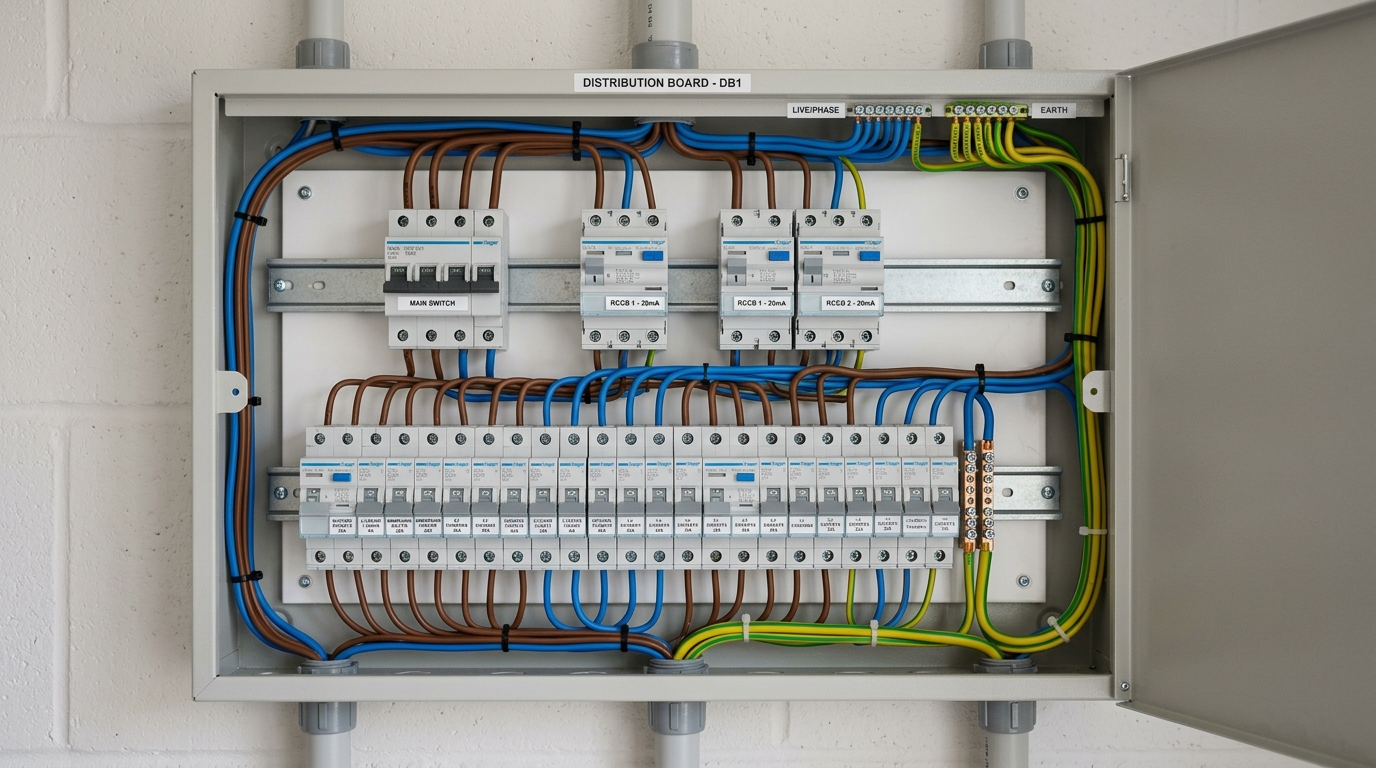
- Dedicated 6mm² or 10mm² Copper Cable Run: Never tap an EV Wallbox off an existing room circuit. Run a dedicated, unbroken 3-core 6mm² (for runs <25 meters) or 10mm² (for runs >30 meters) multi-strand copper cable directly from your main distribution board to the garage.
- Type B Residual Current Device (RCD / RCCB): Standard Type AC or Type A household RCCBs cannot detect smooth DC residual leakage currents generated by electric vehicle onboard rectifiers. International standard IEC 61851 mandates that EV charging circuits must be protected by a Type B RCD (or a Type A RCD paired with an integrated 6mA DC residual direct detection sensor - RDC-DD). A Type B breaker detects high-frequency AC and smooth DC fault currents, cutting power in 30ms to prevent fatal electrocution.
- 32A or 40A Type C Miniature Circuit Breaker (MCB): Install a dedicated 2-pole or 4-pole miniature circuit breaker rated for continuous inductive motor loads.
4. Dedicated Low-Resistance Grounding: The 5-Ohm Safety Prerequisite
Electric vehicle onboard charging computers contain sensitive ground-fault monitoring systems that perform an automated earth impedance check before initiating charging:
- The "Grounding Fault" Charging Lockout: If your home's earth resistance exceeds 10 ohms (common in dry, unmaintained Pakistani earthing pits), the vehicle will illuminate an error light on the dashboard and refuse to charge!
- Dedicated Independent Earth Pit: Drive a 10-foot copper-bonded earth rod near the carport, surrounded by chemical bentonite soil enhancement compound. Connect the earthing conductor (minimum 10mm² green/yellow copper) directly to the Wallbox PE terminal. Earth resistance must measure strictly under 5.0 ohms.
5. Off-Peak Night-Time Charging Strategy: Scheduled Charging Timers
Charging an electric car during peak evening hours (6:00 PM to 10:00 PM or 7:00 PM to 11:00 PM) is economic madness under Pakistani Time of Use tariffs:
- The Peak Hour Penalty: Charging a 60 kWh battery during peak hours (@ Rs. 68/unit) costs over Rs. 4,080 per charge.
- The Off-Peak Scheduled Strategy: Charge strictly between 12:00 AM midnight and 6:00 AM, when off-peak rates apply (@ Rs. 42/unit). That exact same full charge costs only Rs. 2,520—saving Rs. 1,560 on every single charge session!
- Smartphone App Automation: Set an automated charging schedule in your vehicle's mobile app (e.g. BYD App, MG iSMART) or Wallbox controller. Simply plug in the charging gun when arriving home from work at 6:00 PM; the car stays dormant and automatically starts drawing power at exactly 12:01 AM while you sleep!
6. Rooftop Solar Integration: The 100% Free Commuting Dream
Pairing an electric vehicle with a rooftop solar net metering system in Pakistan creates the ultimate self-sustaining personal transport loop:
- Solar Sizing for EV Commuters: An average daily commute of 50 km requires approximately 8.0 kWh of electrical energy. A standard 10kW rooftop solar system in Pakistan generates between 35 and 45 kWh per day. Allocating just 20% to 25% of your solar array's daily generation to your vehicle completely fuels your daily transportation!
- Virtual Solar Storage via Net Metering: You do not need to charge your car during the daytime while parked at your office. During the day, your rooftop panels export surplus units to the utility grid, building up billing credits. At night, you recharge your car using those exact credits, achieving 100% free, zero-emission transportation!
7. Battery Health & 20-80% Charging Protocol for Hot Pakistani Climates
Pakistani summer ambient temperatures (reaching 46°C in Punjab and Sindh) demand proper battery thermal hygiene:
- The 20% to 80% State of Charge (SOC) Golden Rule: For Lithium Nickel Manganese Cobalt (NMC) batteries, avoid charging to 100% daily or letting the battery sit below 10%. Maintaining your battery between 20% and 80% for routine city commuting minimizes cathode stress and doubles cell operational cycle life. (Note: Lithium Iron Phosphate - LiFePO4 / Blade batteries can be charged to 100% once a week for cell balance calibration).
- Never Fast-Charge Immediately After High-Speed Highway Driving: After driving at 120 km/h on the M-2 or M-3 Motorway in blistering 44°C heat, let the battery rest in a shaded garage for 30 minutes before initiating charging to allow the active liquid thermal management system to cool the cell core.
8. Frequently Asked Questions (FAQ)
How much does it cost to fully charge an electric car at home in Pakistan?
Recharging a 60 kWh battery pack (such as BYD Atto 3 or MG4) at home on off-peak grid rates costs approximately Rs. 2,400 to Rs. 2,600, providing around 350 to 400 km of driving range (approx. Rs. 6.50 per km).
Can I charge an electric car using a normal 16-Amp socket in Pakistan?
Yes, using the portable charger provided with the car. However, it takes 18 to 22 hours for a full charge and requires a verified heavy-gauge copper wiring circuit with earthing resistance under 5 ohms.
How fast does a 7kW home Wallbox charger charge an EV?
A 7.4kW AC Wallbox delivers approximately 45 to 55 km of driving range per hour, fully recharging a standard 60 kWh electric car in 7 to 8 hours overnight.
Can I charge my electric vehicle directly from rooftop solar panels?
Yes! By using net metering credits generated during the day, you can charge your car at night using accumulated solar credits, achieving 100% free daily commuting.
Need to check or calculate your current utility bill?
Verify your electricity duplicate bill with instant photo-reading verification or calculate slab costs accurately.