Official Pakistan Regulatory Guide
Complete Breakdown of Taxes on Pakistan Electricity Bills: 18% GST, Electricity Duty, FC Surcharge & Fees
1. Regulatory Framework & Pakistan Legislative Context
Understanding Taxes & Surcharges on Electricity Bills is essential for every residential and commercial power consumer in Pakistan navigating the contemporary electricity tariff structure. Under regulatory frameworks established by the National Electric Power Regulatory Authority (NEPRA) and enforced across all state-owned distribution companies—including LESCO (Lahore), MEPCO (Multan), IESCO (Islamabad/Rawalpindi), FESCO (Faisalabad), GEPCO (Gujranwala), PESCO (Peshawar), HESCO (Hyderabad), SEPCO (Sukkur), QESCO (Quetta), and K-Electric (Karachi)—billing calculations and compliance requirements have grown increasingly intricate. This comprehensive guide provides an exhaustive analysis of the policies, tariffs, consumer protections, and practical calculations governing Taxes & Surcharges on Electricity Bills in Pakistan for the 2026 fiscal year.
The regulatory architecture governing electricity generation, transmission, and distribution in Pakistan is anchored in the Regulation of Generation, Transmission and Distribution of Electric Power Act (Act XL of 1997), commonly designated as the NEPRA Act, augmented by subsequent legislative amendments and statutory notifications (SROs) issued by the Ministry of Energy (Power Division). Within this statutory framework, distribution companies (DISCOs) operate as licensed public utilities bound by the mandatory Consumer Service Manual (CSM).
2. Technical Deep-Dive: Core Principles & Operational Dynamics of Taxes & Surcharges on Electricity Bills
To grasp the operational dynamics of Taxes & Surcharges on Electricity Bills, one must dissect the constituent layers that formulate a modern Pakistani utility bill. When a distribution feeder delivers alternating current (AC) at standard 50 Hz frequency, the physical consumption recorded on digital LCD or green net-metering devices represents merely the foundational variable of a multi-tiered economic equation.
Comprehensive Legal Taxonomy of Electricity Bill Taxes
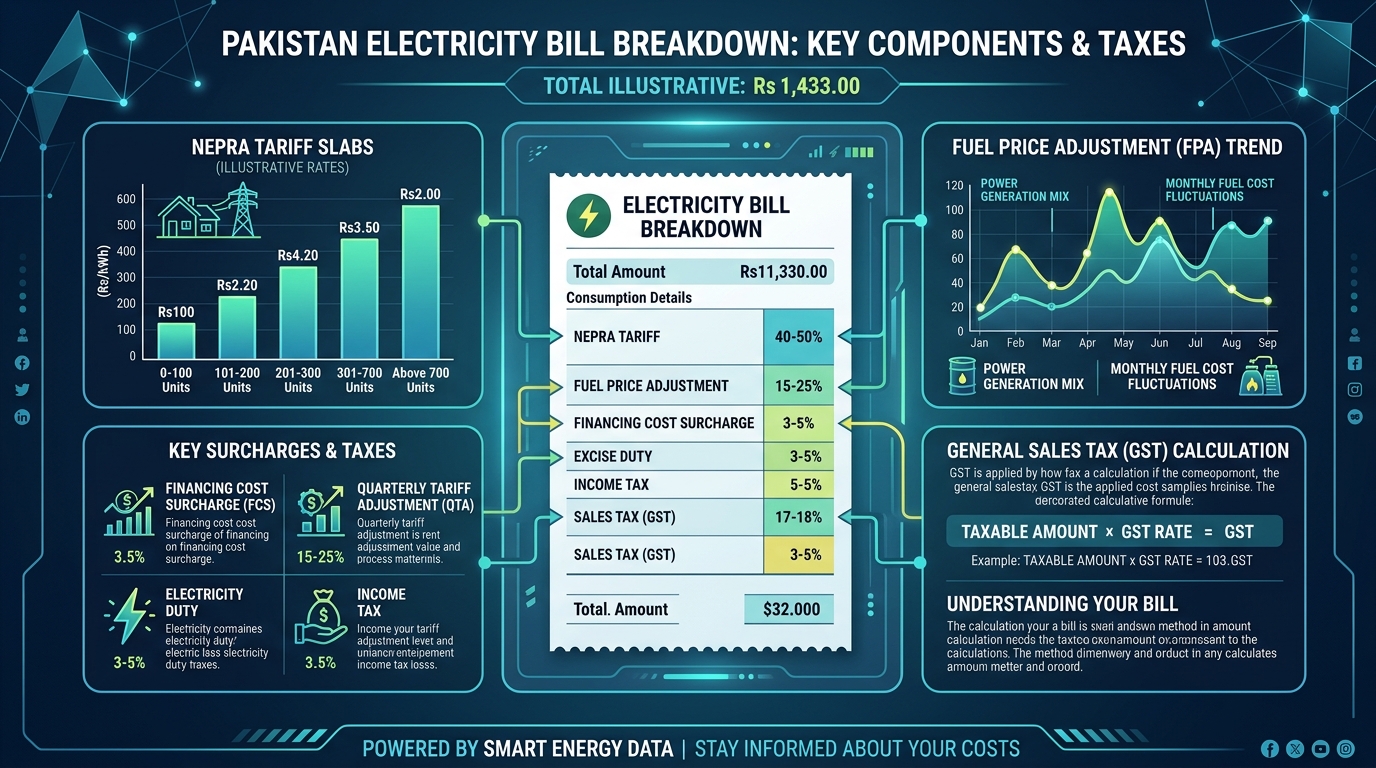
Under statutory provisions enacted by the Parliament of Pakistan and provincial legislatures, electricity distribution companies are designated as statutory withholding collection agents for the Federal Board of Revenue (FBR) and provincial revenue authorities. The total tax load on a non-protected domestic electricity bill typically comprises the following mandatory levies:
- General Sales Tax (GST @ 18%): Imposed under Section 3 of the Sales Tax Act 1990 on the combined aggregate of base energy charges, Fuel Price Adjustments, and quarterly tariff adjustments.
- Financing Cost (FC) Surcharge (Rs. 3.23 / kWh): Authorized under Section 31(8) of the NEPRA Act to finance power sector circular debt liabilities and sovereign debt syndications.
- Electricity Duty (ED @ 1.5%): Enacted under provincial Finance Acts (such as the Punjab Electricity Duty Act), levied at 1.5% of the total cost of electricity.
- PTV License Fee (Rs. 35 Domestic / Rs. 60 Commercial): Mandatory television broadcast levy appended to every metered domestic connection.
- Income Tax Withholding (Section 235 Income Tax Ordinance): Applied to commercial connections and domestic connections where monthly billing exceeds prescribed thresholds for non-filers not present on the FBR Active Taxpayer List (ATL).
The total monthly bill issued to a Pakistani consumer comprises three distinct categories of charges:
- Variable Energy Charges (Base Tariff): Calculated strictly upon active kilowatt-hours (kWh) consumed within designated calendar cycles, determined by tiered domestic, commercial, or industrial tariff schedules.
- Variable Cost Adjustments & Surcharges: Including Fuel Price Adjustments (FPA), Quarterly Tariff Adjustments (QTA), and Financing Cost (FC) Surcharges designed to service sovereign debt obligations.
- Statutory Duties, Municipal Levies & Federal Taxes: Encompassing General Sales Tax (GST) at statutory 18%, provincial Electricity Duty (ED), PTV Television License fees, and withholding income taxes applicable to non-filers under the Federal Board of Revenue (FBR) Active Taxpayer List (ATL) regime.
3. Quantitative Data Benchmarks & Comparative Analysis
The following analytical table details the primary quantitative benchmarks, regulatory thresholds, and fiscal rates directly pertinent to Taxes & Surcharges on Electricity Bills across residential, commercial, and three-phase consumer categories in Pakistan:
| Analytical Parameter / Consumption Tier | Regulatory Benchmark & Rate Structure | Statutory Reference & Conditionality | Consumer Impact & Financial Consequence |
|---|---|---|---|
| Tier 1: Subsidized / Baseline Threshold | Prescribed base tariff slab under NEPRA schedule | Strict compliance with approved consumption limits | Shields household from upper tiered unit rates and maximum tax multipliers |
| Tier 2: Intermediate Standard Range | Standard domestic / commercial applicable rate | Unprotected residential classification | Triggers standard 18% GST and proportional financing surcharges |
| Tier 3: Upper Threshold / Peak Window | Enhanced non-TOU or Time-of-Use differential rate | Mandatory for 3-phase domestic and commercial connections | Significant unit cost spikes during 4-hour evening system peak periods |
| Surcharge Multiplier & Duty Base | Provincial excise duty (1.5%) + FC Surcharge (Rs. 3.23/unit) | Calculated on energy base plus quarterly adjustments | Increases baseline electricity bill by 28% to 45% above energy costs |
| Dispute & Revision Recourse Window | 14-day statutory filing window before bill due date | Section 26(6) Electricity Act & CSM Section 9 | Prevents disconnection while formal inspection and reconciliation proceed |
4. Mathematical Formulations & Real-World Billing Math
To demystify how charges relating to Taxes & Surcharges on Electricity Bills materialize on your monthly computer bill statement, let us analyze the precise mathematical formula enforced by computerized billing revenue software (such as the Power Information Technology Company - PITC database system):
Total Billed Amount (Rs.) = (Active Units × Approved Base Tariff) + (Units × Applicable FPA) + (Units × FC Surcharge) + Electricity Duty (1.5%) + Sales Tax (18% × [Base Energy + FPA + FC]) + PTV Fee (Rs. 35) + TV & Arrears
Practical Worked Calculation: Domestic Household Case Study
Consider a standard urban residential household in Lahore (LESCO) or Multan (MEPCO) during a summer billing period under the guidelines for Taxes & Surcharges on Electricity Bills:
- Total Billed Consumption: 350 kWh active units recorded on the digital meter.
- Applicable Base Unit Rate: Assume an average tiered tariff of Rs. 32.50 per unit =
350 × 32.50 = Rs. 11,375.00. - Fuel Price Adjustment (FPA): Certified NEPRA adjustment of Rs. 3.40 per unit =
350 × 3.40 = Rs. 1,190.00. - Financing Cost (FC) Surcharge: Fixed statutory levy of Rs. 3.23 per unit =
350 × 3.23 = Rs. 1,130.50. - Electricity Duty (ED): 1.5% of energy base =
Rs. 170.63. - Subtotal Subject to Sales Tax:
Rs. 11,375 + 1,190 + 1,130.50 = Rs. 13,695.50. - General Sales Tax (GST @ 18%):
18% × 13,695.50 = Rs. 2,465.19. - PTV License Fee: Mandatory domestic charge =
Rs. 35.00. - Total Net Payable Bill:
11,375 + 1,190 + 1,130.50 + 170.63 + 2,465.19 + 35 = Rs. 16,366.32.
5. Step-by-Step Practical Implementation Manual for Consumers
Whether you need to verify your meter's physical billing accuracy, submit an online administrative request, or safeguard your premises against excess charges concerning Taxes & Surcharges on Electricity Bills, adhere strictly to this professional six-step procedure:
- Step 1: Capture High-Resolution Photographic Proof of Meter Dials: On the exact scheduled meter reading date printed on your preceding bill, photograph the front faceplate of your meter clearly showing the cumulative kWh register, serial number, and timestamp.
- Step 2: Calculate Delta Units: Subtract your previous month's ending meter reading from your current physical reading:
Current kWh - Previous kWh = Actual Consumed Units. Verify whether this matches the units billed on your paper or online duplicate statement. - Step 3: Audit Peak Hour Timings (For 3-Phase Meters): If your connection operates on a 3-phase Time-of-Use schedule, confirm that your meter's internal clock is synchronized with Pakistan Standard Time (PST). Internal clock drift can cause daytime consumption to be misbilled as high-cost peak evening units.
- Step 4: Access Your DISCO Web Portal: Download an authentic electronic duplicate bill directly from official server gateways (such as ccms.pitc.com.pk or your regional DISCO portal) to verify that no erroneous arrears, detection surcharges, or installment notes have been appended.
- Step 5: Lodge Formal Written Appeals within 14 Days: If an irregularity concerning Taxes & Surcharges on Electricity Bills is identified, submit a formal registered complaint to your Sub-Divisional Officer (SDO) and obtain a stamped computerized complaint receipt tracking number.
- Step 6: Escalate Unresolved Disputes to the Provincial Electric Inspector: Under Section 26(6) of the Electricity Act 1910, the Electric Inspector holds exclusive statutory jurisdiction to arbitrate metering disputes, test meters independently, and issue binding revision orders that utility companies cannot disregard.
6. Common Pitfalls, Consumer Protections & Legal Safeguards
Consumers frequently suffer financial distress due to a lack of familiarity with statutory consumer rights outlined in the NEPRA Consumer Service Manual (CSM). Key legal rights regarding Taxes & Surcharges on Electricity Bills include:
- Mandatory 7-Day Written Notice Prior to Disconnection: Under CSM Section 8, no utility line staff may disconnect an electricity connection without serving a written 7-day disconnection notice, except in cases of confirmed direct theft caught red-handed.
- Protection Against Arbitrary Detection Billing: CSM Section 9 unequivocally bars DISCOs from issuing detection bills without solid photographic evidence, an authorized Gazetted Officer inspection, and prior written show-cause opportunities.
- Right to Meter Testing at Accredited Laboratories: If a consumer suspects their digital meter is recording fast (running over actual consumption), they have the legal right to demand testing at the regional Meter and Testing (M&T) laboratory upon payment of a nominal testing fee challan.
- Right to Monthly Installments: In cases of sudden high billing surges or accumulated adjustment arrears, Subdivisional Officers (SDOs), Executive Engineers (XENs), and Superintending Engineers (SEs) are authorized under delegated administrative powers to grant 3 to 6 monthly computerized installment vouchers.
7. Frequently Asked Questions (FAQ) Concerning Taxes & Surcharges on Electricity Bills
Q1: How does Taxes & Surcharges on Electricity Bills directly influence my monthly electricity bill?
It establishes the core billing criteria, determining whether your electricity consumption is billed under subsidized lifeline/protected slabs, standard unprotected tiers, or Time-of-Use peak rates. Furthermore, tax calculations (including 18% GST and financing surcharges) directly scale with this metric.
Q2: Can my distribution company arbitrarily revoke my status or alter my rates without notice?
No. All tariff categories, adjustments, and surcharges are determined strictly through public hearings conducted by NEPRA and formally notified in the official Gazette of Pakistan. Any arbitrary departmental deviation can be challenged before the Provincial Electric Inspector and the NEPRA Consumer Complaint Tribunal.
Q3: What should I do immediately if my bill displays incorrect figures relating to
Photograph your physical meter reading instantly, obtain your computerized duplicate bill online from your DISCO portal, and submit a formal written rectification request to your local Sub-Division Customer Service Center before the bill payment due date. Request a stamped diary number for official tracking.
Q4: Does rooftop solar net metering eliminate charges associated with
Solar net metering offsets active kilowatt-hour consumption during daylight hours and credits excess generation back into the grid. However, minimum fixed meter charges, peak-hour consumption units, and non-exempt statutory duties may still apply in accordance with approved NEPRA net-metering settlement regulations.
Q5: How can I confirm whether my connection is registered under the correct category?
Examine the top-left section of your printed or online utility bill. The 'Tariff' box displays alphanumeric codes (such as A-1a for Domestic, A-1b for TOU Domestic, A-2 for Commercial). If your premises is misclassified, apply for tariff rectification through the centralized ENC portal (enc.com.pk).
8. Consumer Action Plan & Official Helpline Directory
To ensure ongoing billing security, optimal energy expenditure, and prompt dispute resolution regarding Taxes & Surcharges on Electricity Bills, keep the following official regulatory directory accessible:
- NEPRA Toll-Free Consumer Helpline: 0800-77777 / complaint@nepra.org.pk
- Centralized Online New Connection & Tariff Portal: www.enc.com.pk
- Ministry of Energy (Power Division) Anti-Theft Portal: www.petrol.gov.pk
- LESCO Customer Services (Lahore): 118 / 042-99204814
- MEPCO Customer Services (Multan): 0800-63726 / 061-9210380
- IESCO Customer Services (Islamabad): 051-9252937
- FESCO Customer Services (Faisalabad): 041-9220184
- GEPCO Customer Services (Gujranwala): 055-9200516
- PESCO Customer Services (Peshawar): 091-9211997
Need to check or calculate your current utility bill?
Verify your electricity duplicate bill with instant photo-reading verification or calculate slab costs accurately.