Low Power Factor (LPF) Penalty in Pakistan 2026: Automatic Capacitor Banks & Bill Surcharge | BillsOnlinePk
Executive Summary: For commercial plaza owners, industrial factory managers, flour mills, tube wells, and high-load three-phase consumers across Pakistan, receiving a monthly electricity bill with a massive Low Power Factor (LPF) Penalty of Rs. 30,000 to Rs. 250,000 is a frequent and financially devastating occurrence. Under NEPRA commercial and industrial tariff regulations, power distribution companies (MEPCO, LESCO, IESCO, K-Electric, FESCO) enforce a mandatory minimum power factor benchmark of 0.90 lagging. Whenever a facility's average monthly power factor drops below 0.90, the utility levies severe penalty surcharges on every single consumed kilowatt-hour. Installing an engineered Automatic Power Factor Correction (APFC) capacitor bank completely eliminates these penalties and reduces transformer heat losses. This 2026 engineering manual provides exact penalty calculation formulas, kVAR capacitor sizing matrices, detuned harmonic filter specs, and real-world commercial ROI case studies.
Table of Contents (Jump to Section)
- 1. Electrical Fundamentals: Active Power (kW), Reactive Power (kVAR) & Apparent Power (kVA)
- 2. NEPRA Penalty Formulas: How DISCOs Calculate the LPF Surcharge
- 3. Capacitor Bank Engineering: Sizing Required kVAR Rating
- 4. Automatic Power Factor Correction (APFC) Panels vs Fixed Capacitors
- 5. Detuned Harmonic Reactors: Preventing Capacitor Explosions
- 6. Financial Payback & Transformer Capacity Optimization
- 7. Frequently Asked Questions (FAQ)
1. Electrical Fundamentals: Active Power (kW), Reactive Power (kVAR) & Apparent Power (kVA)
To understand the power factor penalty, we must visualize the classic alternating current Power Triangle:
- Active / Real Power (P, measured in Kilowatts - kW): This is the actual productive electrical energy converted into mechanical shaft rotation in motors, thermal heat in heaters, or visible light in lamps. This is the work you actually intend to do.
- Reactive Power (Q, measured in Kilovar - kVAR): Inductive electrical equipment—such as AC induction motors, air conditioner compressors, welding sets, fluorescent ballasts, and transformers—requires an alternating magnetic field to operate. Reactive power does zero mechanical work; it simply sloshes back and forth between the utility generator and the motor stator coils every 50Hz cycle to sustain electromagnetic flux.
- Apparent Power (S, measured in Kilovolt-Amperes - kVA): This is the vector sum of active power and reactive power (S = √(P² + Q²)). This represents the total electrical capacity that utility transformers, transmission cables, and switchgear must physically carry.
- Power Factor (cos φ): The ratio of Active Power to Apparent Power (PF = kW / kVA). A power factor of 1.0 (Unity) means 100% of grid current is performing productive work. A power factor of 0.75 means 25% of grid current is wasted circulating idle magnetizing flux, forcing the utility to oversize distribution conductors.

2. NEPRA Penalty Formulas: How DISCOs Calculate the LPF Surcharge
Under NEPRA commercial (A-2 above 5kW), industrial (B-1, B-2, B-3), and agricultural tubewell (Tariff D) schedules, the Low Power Factor Penalty is enforced strictly:
- Statutory Benchmark (0.90 Lagging): Consumers are required to maintain an average monthly power factor of at least 0.90 (90%). If your power factor is 0.92, there is zero penalty.
- Penalty Rate Structure: For every 1% (0.01) that the monthly power factor drops below 0.90, the consumer's base energy charge (total active kWh cost) is penalized by an additional 0.5% to 1.0% surcharge:
Achieved Power Factor Percentage Below 0.90 Benchmark Penalty Surcharge Applied to Base Energy Charge Sample Penalty on Rs. 300,000 Monthly Bill 0.90 to 0.98 0.00% (Compliant) Rs. 0.00 (Zero Penalty) Rs. 0 0.85 5% Below Threshold +2.5% to +5.0% Surcharge +Rs. 7,500 to +Rs. 15,000 0.80 10% Below Threshold +5.0% to +10.0% Surcharge +Rs. 15,000 to +Rs. 30,000 0.72 18% Below Threshold +9.0% to +18.0% Surcharge +Rs. 27,000 to +Rs. 54,000 0.65 25% Below Threshold +12.5% to +25.0% Surcharge +Rs. 37,500 to +Rs. 75,000
3. Capacitor Bank Engineering: Sizing Required kVAR Rating
To eliminate reactive power draw from the utility grid, consumers install static or automatic power factor correction (APFC) capacitor banks. Capacitors generate leading reactive current that cancels out the lagging inductive reactive current of motors locally:
Mathematical Sizing Formula:
Required Capacitor kVAR = Active Load (kW) × [tan(cos⁻¹ PF_initial) - tan(cos⁻¹ PF_target)]
Practical Commercial Example: A small packaging factory in Lahore runs a 100 kW motor load with an initial lagging power factor of 0.75, incurring heavy penalties. The owner wants to raise the power factor to 0.96:
- PF_initial = 0.75 → tan(cos⁻¹ 0.75) = tan(41.4°) = 0.882
- PF_target = 0.96 → tan(cos⁻¹ 0.96) = tan(16.3°) = 0.292
- Multiplier = 0.882 - 0.292 = 0.590
- Required Capacitor Bank = 100 kW x 0.590 = 59.0 kVAR (Select standard 60 kVAR APFC Panel).
4. Automatic Power Factor Correction (APFC) Panels vs Fixed Capacitors
Connecting fixed capacitors directly across a main busbar can cause catastrophic over-compensation:
- The Leading Power Factor Danger: When factory machines shut down at night while fixed capacitors remain connected, the power factor shifts into a leading power factor (e.g. 0.85 leading). Leading power factor causes utility grid overvoltages (Ferranti effect), damages electronic equipment, and under Pakistani utility rules, certain DISCOs penalize leading power factor identically to lagging power factor!
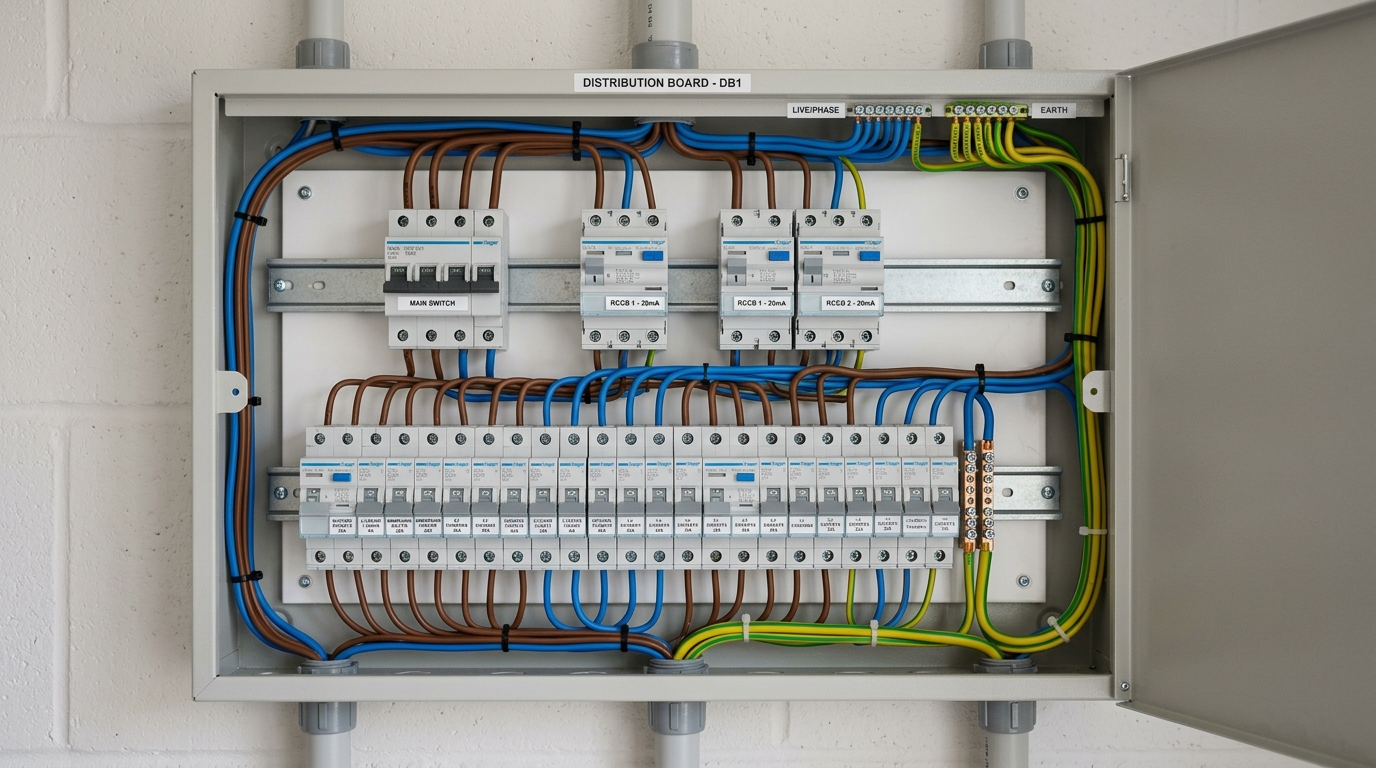
- Microprocessor APFC Relays: An APFC panel utilizes an intelligent electronic controller (manufactured by Schneider, ABB, Lovato, or Epcos) that monitors real-time voltage and current via a Current Transformer (CT). As inductive loads switch on and off, the controller automatically energizes or de-energizes modular capacitor steps (e.g. 5 kVAR, 10 kVAR, 20 kVAR steps) in seconds, keeping power factor precisely locked between 0.95 and 0.98 lagging 24 hours a day.
5. Detuned Harmonic Reactors: Preventing Capacitor Explosions
In modern industrial facilities operating Variable Frequency Drives (VFDs), solar inverters, and computer switching power supplies, standard power factor capacitors frequently swell, leak dielectric oil, and explode:
- Harmonic Resonance Amplification: Non-linear loads inject 5th (250Hz) and 7th (350Hz) harmonic currents into the electrical network. Capacitors have lower impedance at higher frequencies, causing them to absorb massive harmonic currents that overheat dielectric film.
- 7% Detuned Harmonic Reactors: To protect capacitors, connect series iron-core detuned reactors (typically 7% impedance, tuned to 189Hz). The reactor blocks harmonic frequencies from entering the capacitors while allowing fundamental 50Hz reactive compensation to proceed smoothly.
6. Financial Payback & Transformer Capacity Optimization
Investing in an APFC capacitor bank offers one of the highest returns on investment in industrial engineering:
- Instant Payback in Under 90 Days: An industrial consumer paying Rs. 40,000 in monthly LPF penalties can install a 50 kVAR APFC panel for approximately Rs. 110,000 to Rs. 130,000. By eliminating the penalty completely, the hardware investment pays for itself in less than 3 to 4 months.
- Releasing Transformer Capacity: Raising power factor from 0.75 to 0.95 reduces total line current by 21%. This reduces copper I²R heating losses in your factory cables, runs distribution transformers substantially cooler, and frees up electrical capacity to add new manufacturing machines without upgrading your sanctioned transformer size!
7. Solar Inverter Displacement Power Factor & Grid Interconnection Tuning
A surprising technical dilemma encountered by commercial solar system owners in Pakistan is the emergence of Low Power Factor penalties AFTER installing rooftop on-grid solar panels! When a grid-tied solar inverter supplies 80kW of active power to a 100kW commercial load, the utility meter only records 20kW of active grid power. However, standard on-grid inverters typically operate at unity power factor (PF = 1.0), meaning they supply ZERO reactive power (kVAR).
Because the factory motors continue demanding their full 60 kVAR of inductive reactive power, all 60 kVAR must now be drawn entirely from the utility grid against only 20kW of active grid energy! The utility meter calculates the ratio (20kW / √(20² + 60²)) and records an abysmal power factor of 0.31 lagging, triggering massive penalty surcharges that wipe out solar savings! Commercial solar engineers must program the solar inverters into "Reactive Power Priority Mode" (Q-Mode) or adjust local APFC capacitor steps to compensate for solar displacement factor.
7. Frequently Asked Questions (FAQ)
What is the minimum acceptable power factor in Pakistan to avoid penalties?
Under NEPRA regulations, commercial, industrial, and agricultural consumers must maintain a power factor of at least 0.90 (90%) lagging. Any reading below 0.90 incurs immediate financial penalty surcharges.
Do residential domestic consumers get penalized for low power factor in Pakistan?
Standard domestic residential consumers (Tariff A-1) are billed purely on active kilowatt-hours (kWh) and do not currently pay low power factor penalties. However, maintaining good power factor still reduces internal home wiring heat losses.
What causes low power factor in a commercial building?
Low power factor is caused by inductive electrical equipment, including electric induction motors, air conditioner compressors, water pumps, refrigerators, and fluorescent magnetic ballasts.
Can a capacitor bank lower my overall electricity bill beyond eliminating the penalty?
Yes. In addition to wiping out 100% of the LPF penalty surcharge, capacitors reduce total circuit current by up to 20%, which decreases internal resistive heat losses in your cables and switchgear.
Q5: How do I know if my facility is currently paying a Low Power Factor penalty?
Examine the itemized charges on your commercial or industrial utility bill. Look for the line item labeled "LPF Penalty" or "Low Power Factor Surcharge" located below the base energy charges.
Q6: Can power factor capacitors be left on when the factory is closed?
No! Leaving fixed capacitors connected when machinery is off creates a leading power factor, causing grid overvoltages and potential utility fines. Use automatic APFC relays that disengage capacitors during zero-load periods.
Need to check or calculate your current utility bill?
Verify your electricity duplicate bill with instant photo-reading verification or calculate slab costs accurately.