Deep Cycle Tubular Battery Maintenance in Pakistan 2026: Specific Gravity & Distilled Water Guide | BillsOnlinePk
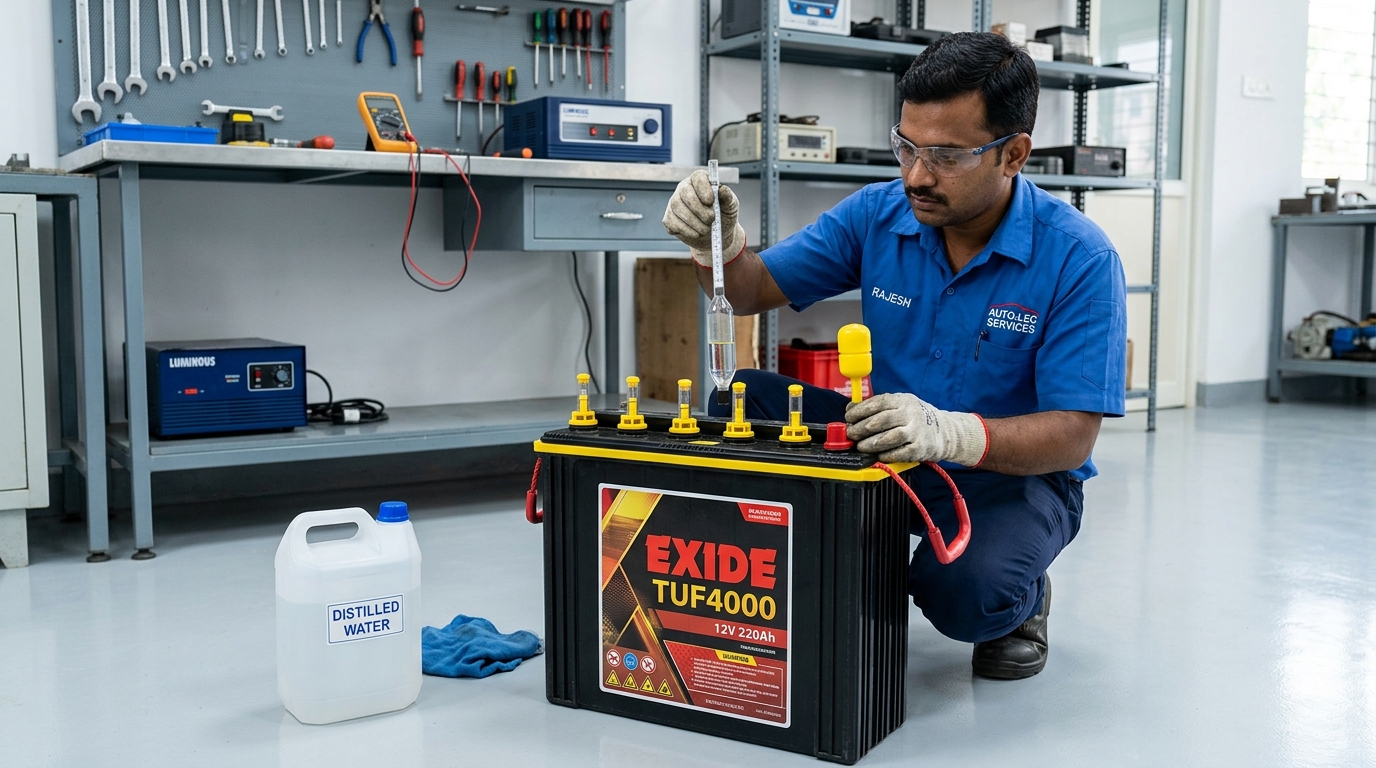
Executive Summary: In Pakistan, where summer temperatures frequently exceed 45°C and utility grid load shedding remains a daily reality, deep-cycle tubular lead-acid batteries (manufactured by Exide, Phoenix, AGS, Osaka, and Volta) represent the primary energy storage backbone for millions of households and solar installations. However, due to widespread maintenance neglect and incorrect charging parameters, over 65% of tubular batteries in Pakistan suffer premature failure within 14 to 18 months, despite being engineered for a design lifespan of 4 to 5 years. Homeowners frequently ruin expensive battery banks by pouring municipal tap water into cells, ignoring electrolyte specific gravity stratification, or using cheap local chargers that boil away acid. This definitive 2026 engineering manual provides exact hydrometer gravity reading charts, water topping protocols, equalization charging voltage benchmarks, and terminal corrosion prevention methods to ensure your tubular battery bank achieves its full multi-year service life.
Table of Contents (Jump to Section)
- 1. Electrochemical Architecture: Why Tubular Plates Outlast Automotive Batteries
- 2. Electrolyte Specific Gravity: The Universal Battery Health Truth
- 3. The Fatal Mistake: Never Add Acid, Tap Water, or Mineral Water
- 4. Float Indicator Alignment & Distilled Water Topping Protocols
- 5. Inverter Charging Parameters: Bulk, Float & Equalization Voltages
- 6. Terminal Care: Eliminating Green-White Copper Corrosion (Copper Sulfate)
- 7. Temperature Derating: Mitigating 45°C Pakistani Summer Heat Degradation
- 8. Frequently Asked Questions (FAQ)
1. Electrochemical Architecture: Why Tubular Plates Outlast Automotive Batteries
To maintain a tubular battery correctly, one must understand how its internal electrochemistry differs from standard automotive car batteries:
- Flat-Plate Automotive Batteries (SLI - Starting, Lighting, Ignition): Automotive batteries feature thin, spongy lead plates designed to deliver massive cranking amperes (300A to 500A) for 3 seconds to start an internal combustion engine. When subjected to deep discharges (such as running ceiling fans and lights during a 3-hour power outage), the active lead dioxide material sloughs off the thin grid, depositing as conductive sludge at the bottom of the cell and causing fatal short circuits within 6 to 9 months.
- Gauntlet Tubular Plate Technology: Deep-cycle tubular batteries encase the positive active material inside multi-tube woven polyester fabric "gauntlets" reinforced with high-pressure die-cast antimony-lead spines. This physical armor prevents active lead mass from shedding during severe 80% Depth of Discharge (DOD) cycles. Combined with high electrolyte volume reservoirs, tubular batteries withstand 1,200 to 1,500 deep discharge cycles when properly maintained.

2. Electrolyte Specific Gravity: The Universal Battery Health Truth
Measuring battery terminal voltage with a standard digital multimeter gives a deceptive picture of state-of-charge because surface charges mask underlying chemical depletion. The only scientifically irrefutable measurement of battery health is the Specific Gravity of the Sulfuric Acid (H₂SO₄) Electrolyte measured with a glass float hydrometer:
| Specific Gravity Reading (@ 27°C) | State of Charge (SOC) | Individual Cell Open-Circuit Voltage | Chemical Condition & Action Required |
|---|---|---|---|
| 1.250 - 1.260 | 100% Fully Charged | 2.12V - 2.14V | Optimal condition. Healthy sulfuric acid concentration. |
| 1.220 - 1.230 | 75% Charged | 2.07V - 2.09V | Normal discharge zone. Needs regular recharge cycle. |
| 1.180 - 1.200 | 50% Discharged | 2.02V - 2.04V | Minimum recommended discharge limit to prevent plate damage. |
| 1.140 - 1.160 | 25% Discharged | 1.97V - 1.99V | Deep discharge warning. Lead sulfate crystals beginning to harden. |
| Below 1.120 | 0% Completely Dead | Under 1.95V | Severe chemical starvation. Requires immediate equalization desulfation. |
Cell Variance Rule: If five cells in a 12V battery test at 1.250 gravity while a single cell tests below 1.180, that individual cell has developed an internal micro-short or severe sulfation, dragging down the entire battery bank's storage capacity.
3. The Fatal Mistake: Never Add Acid, Tap Water, or Mineral Water
The most catastrophic maintenance error committed by Pakistani consumers is improper fluid topping:
- Why You Must NEVER Add Acid: When a battery discharges, sulfate ions leave the liquid electrolyte and bond to the lead plates as lead sulfate. During recharging, these sulfate ions are driven back into the liquid, restoring acid concentration. The sulfuric acid molecules NEVER evaporate! Only pure water (H₂O) splits into hydrogen and oxygen gas (electrolysis) and evaporates. Adding fresh acid (commercial battery electrolyte) raises acid concentration to toxic levels, accelerating plate grid corrosion and destroying the battery within months!
- The Tap Water & Mineral Water Poison: Municipal groundwater and bottled drinking water across Pakistan contain dissolved calcium, magnesium, chlorides, and iron. Pouring tap water into a battery introduces these metallic minerals into the chemical bath. Iron and chlorides cause aggressive self-discharge and irreversible plate poisoning. Always use certified, laboratory-tested Deionized or Distilled Water with zero Total Dissolved Solids (TDS < 5 ppm).

4. Float Indicator Alignment & Distilled Water Topping Protocols
Modern Pakistani tubular batteries feature vent caps equipped with floating red/yellow level indicators:
- Understanding Float Indicators: As water evaporates, the float stem drops down into the cell vent. When the red indicator line approaches the bottom ring, distilled water must be added. Never allow liquid levels to drop below the top of the internal lead gauntlets; exposed plates oxidize rapidly upon contact with air, permanently destroying their active surface area.
- When to Top Up Water (Crucial Timing): Always top up distilled water AFTER the battery has been fully recharged, never when it is discharged! When a battery charges, electrolyte expands thermally and increases in volume. If you fill a discharged battery to the top mark, the fluid will overflow and spill corrosive acid over your floor during final charging absorption!
- Maintain Correct Headspace: Fill only until the float stem rises to the green safe band (approximately 15mm below the bottom of the vent plug threads).

5. Inverter Charging Parameters: Bulk, Float & Equalization Voltages
A major cause of premature battery death in Pakistan is running solar inverters with factory-default lead-acid profiles that undercharge or overcharge tubular chemistries:
- Bulk / Absorption Voltage Setting: Deep cycle tubular batteries require higher absorption voltages to overcome internal chemical resistance. Program your hybrid inverter (Inverex, Growatt, Knox, Crown, Fronus) to 14.6V to 14.8V per 12V battery (or 29.2V - 29.6V for 24V banks, 58.4V - 59.2V for 48V banks). Undercharging below 14.4V causes chronic plate sulfation.
- Float Charge Voltage: Once charged, maintain float voltage at 13.6V to 13.8V per battery. This provides sufficient trickle current to counteract self-discharge without causing excessive water electrolysis.
- Equalization Charge (Every 30 to 45 Days): Equalization is a controlled, deliberate overcharge that raises voltage to 15.2V to 15.5V for 2 hours with low current (5% of Ah rating). The vigorous bubbling (gassing) remixes stratified electrolyte layers and strips hardened sulfate crystals from plate surfaces, fully restoring lost capacity.
6. Terminal Care: Eliminating Green-White Copper Corrosion (Copper Sulfate)
Corrosion on battery terminals creates high electrical resistance, causing severe voltage drops during high-load inverter operation:
- The Hot Water & Baking Soda Remedy: When battery acid vapors escape past loose terminal posts, they react with copper lugs and lead terminals to form a crusty turquoise-white powder (copper sulfate). Dissolve 2 tablespoons of baking soda (sodium bicarbonate) in 500ml of boiling hot water. Pour slowly over the corroded terminals. The alkaline solution neutralizes the acid instantly with vigorous fizzing, leaving clean metal surfaces.
- Protective Petroleum Jelly Seal: After scrubbing terminals clean with a wire brush and tightening terminal bolts firmly, coat all exposed lead and copper surfaces with a generous layer of pure petroleum jelly (Vaseline) or specialized battery terminal grease. Never use engine grease or motor oil, as petroleum hydrocarbon additives can degrade plastic battery lids.
7. Temperature Derating: Mitigating 45°C Pakistani Summer Heat Degradation
Heat is the ultimate enemy of lead-acid battery chemistry. According to the Arrhenius Rate Law, for every 10°C increase in operating temperature above 25°C, internal chemical reaction speeds double—and battery service life is cut in half:
- Summer Heat Hazard: In Multan, Lahore, or Jacobabad where utility rooms or rooftop verandas reach 46°C in June, a tubular battery operates under intense chemical stress, suffering accelerated grid corrosion and rapid water boil-off.
- Optimal Installation Environment: Always place your battery bank in a shaded, ground-floor utility space with unrestricted natural airflow. Maintain at least 6 inches of clearance between adjacent battery cases to allow heat dissipation, and install a low-wattage 12V DC exhaust fan to vent hydrogen gases safely outdoors.
8. Frequently Asked Questions (FAQ)
What is the correct specific gravity for a fully charged tubular battery in Pakistan?
A fully charged tubular battery at 27°C should test between 1.250 and 1.260 specific gravity on a float hydrometer. Any reading below 1.200 indicates undercharging or advanced sulfation.
How often should I add distilled water to my tubular battery in summer?
In peak Pakistani summer (May to August), check water level indicators every 15 to 20 days. In cooler winter months, checking once every 30 to 45 days is usually sufficient.
Can I add acid to my tubular battery if the water level is low?
NEVER add acid! Sulfuric acid does not evaporate; only water evaporates. Adding acid increases concentration to destructive levels and ruins the internal lead plates within weeks.
What is the normal lifespan of a tubular battery in Pakistan?
With proper distilled water maintenance, correct inverter charging voltages (14.6V bulk), and routine equalization every 40 days, a quality tubular battery (Exide, Phoenix, AGS) reliably lasts 4 to 5 years.
Q5: Can I mix old and new tubular batteries in the same bank?
Never mix batteries of different ages, capacities, or brands in series. The older battery with higher internal resistance will degrade the new battery rapidly, causing chronic undercharging and cell imbalance.
Q6: What should I do if acid spills on my floor during topping?
Immediately sprinkle baking soda (meetha soda) or garden lime over the spill to neutralize the sulfuric acid safely, then mop with abundant fresh water. Wear protective rubber gloves and goggles.
Need to check or calculate your current utility bill?
Verify your electricity duplicate bill with instant photo-reading verification or calculate slab costs accurately.