Zero Export Device (Anti-Reverse Power) Guide 2026: Run Solar Without Net Metering, Prevent Green Meter Fines & CT Sensor Wiring
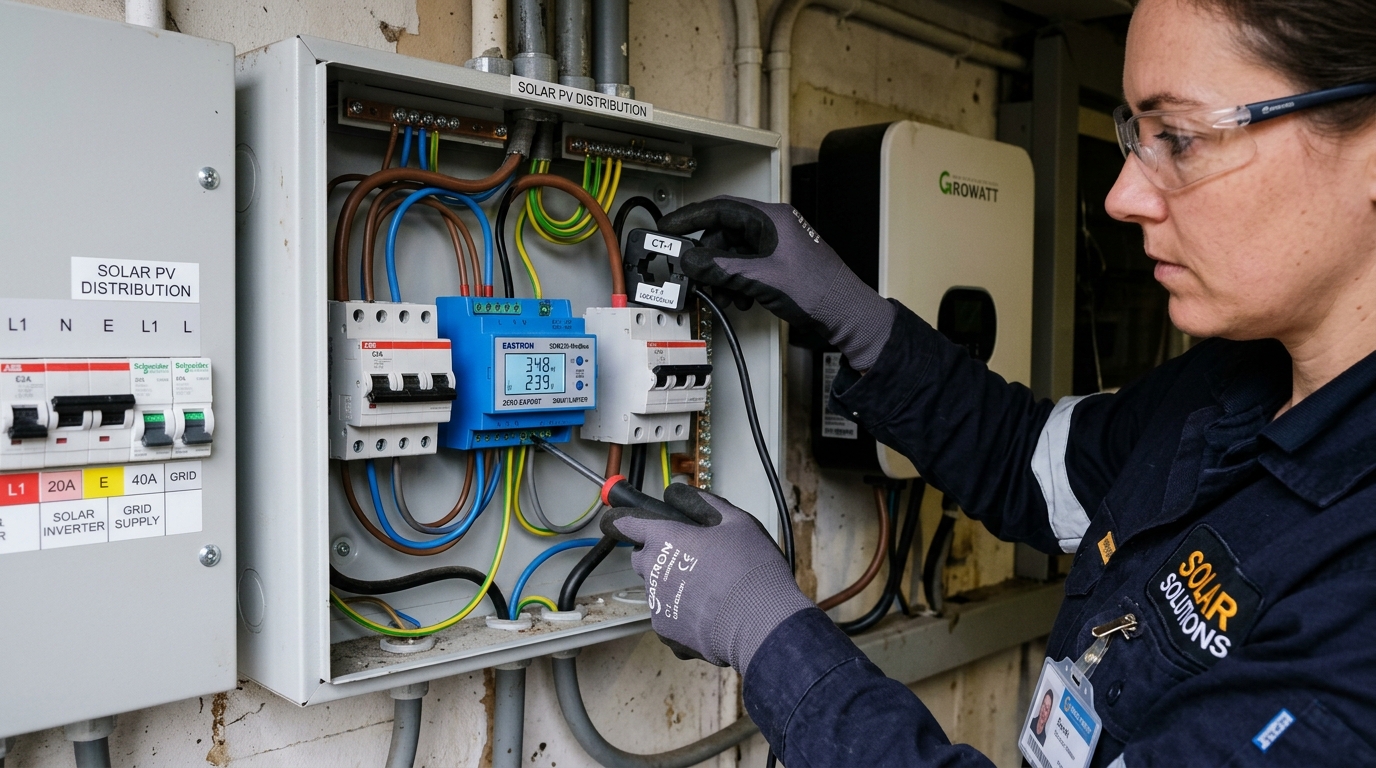
Executive Summary: Applying for a net metering Green Meter in Pakistan can take between 2 to 4 months due to distribution transformer quota bottlenecks, SDO inspections, and bureaucratic backlog. However, homeowners who complete their solar installation want to start powering their air conditioners and cutting daytime electricity bills immediately. If you turn on an on-grid or hybrid solar inverter without net metering, surplus solar power pushes backward through your standard WAPDA meter—causing modern digital meters to either **charge you forward units for the power you export** or trip on power theft (reverse tampering) alarms. Installing a **Zero Export Device (Anti-Reverse Power Controller)** permanently solves this problem.
Table of Contents (Jump to Section)
- 1. What Happens If You Run Solar Without Net Metering or a Limiter?
- 2. How Does a Zero Export Device (Smart Energy Limiter) Work?
- 3. Built-In Inverter Limiters vs External Dedicated Smart Meters
- 4. Step-by-Step Installation & Wiring Diagram Guide
- 5. Transitioning to Net Metering: Seamless Upgrade Workflow
- 6. Current Transformer (CT) Orientation, Polarity Testing & Multi-Inverter Topology
- 7. Frequently Asked Questions (FAQ)
1. What Happens If You Run Solar Without Net Metering or a Limiter?
Depending on your electricity meter type, this creates catastrophic consequences:
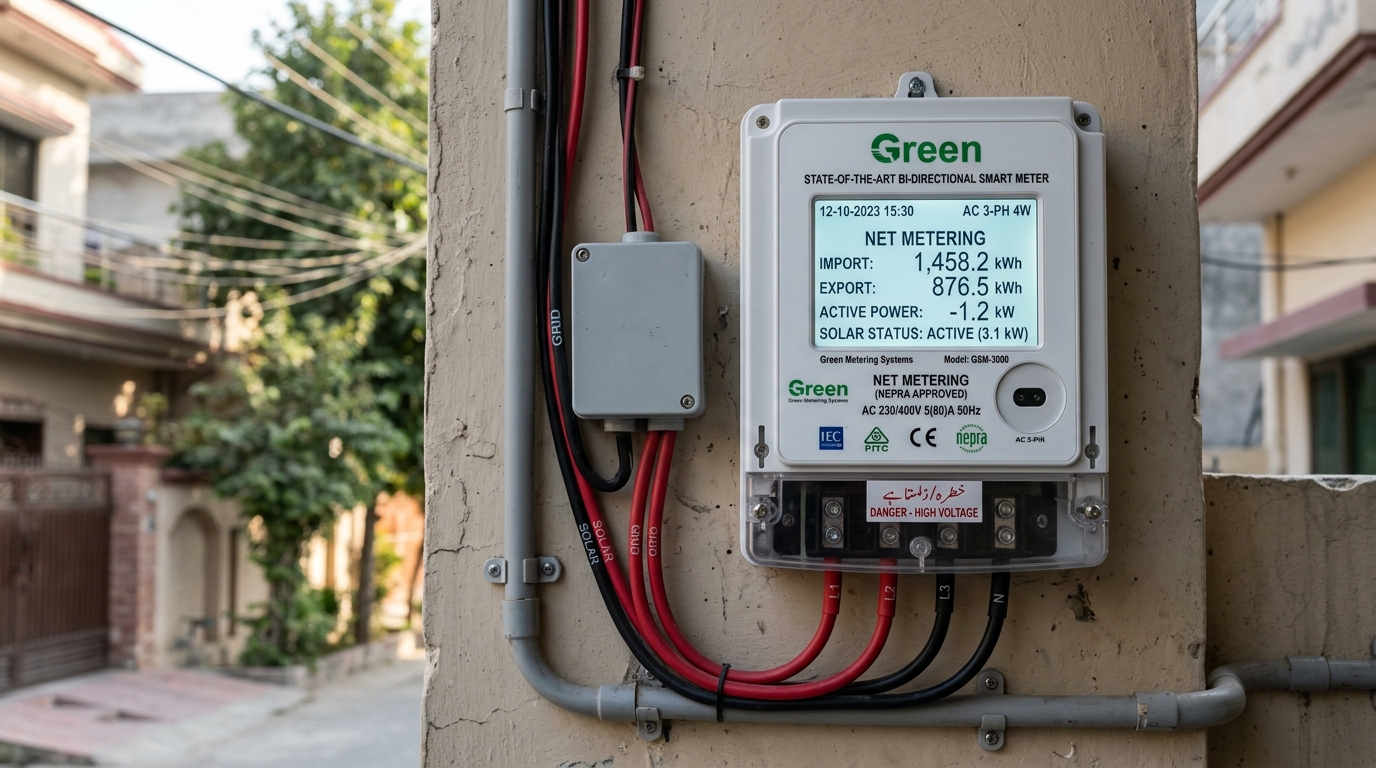
- Digital Static Electronic Meters: Most digital static meters installed by MEPCO, LESCO, and IESCO are programmed with an absolute mathematical algorithm ($|Active Power|$). They cannot distinguish between incoming and outgoing current! If you export 200 units of solar energy, the meter increments the register forward by 200 units, **literally doubling your electricity bill**!
- Smart AMI Meters: Smart meters log an active
REVERSE CURRENTorTAMPERevent in their internal non-volatile memory and alert the central utility server, prompting field inspectors to arrive with electricity theft notices! - Mechanical Induction Disk Meters: Old mechanical dial meters spin backwards, which is illegal under Section 39 of the Electricity Act and triggers massive retrospective detection bills.
2. How Does a Zero Export Device (Smart Energy Limiter) Work?
- Current Transformer (CT Clamp) or Eastron Smart Meter: Clamped around the main incoming utility phase wire directly after your main electricity meter. It measures the direction and magnitude of electrical current at a sampling frequency of 1,000 times per second.
- RS485 Modbus Telemetry Cable: Relays instantaneous power readings to the solar inverter's microprocessor.
If your house consumes 3.5 kW, the inverter generates exactly 3.5 kW. If someone turns off a 1.5-ton AC and house load drops to 1.5 kW, the CT clamp detects micro-amperes beginning to flow toward the grid. Within 100 milliseconds, the inverter adjusts its internal MPPT pulse-width modulation, reducing solar panel power production to exactly 1.5 kW. Net power exported to WAPDA remains **precisely 0.00 Watts** at all times!
3. Built-In Inverter Limiters vs External Dedicated Smart Meters
| Limiter Architecture | Hardware Required | Response Time | Accuracy & Safety |
|---|---|---|---|
| Internal Inverter CT Clamp (Inverex Nitrox, Solis, Deye) | Single/Three-Phase CT clamp included in inverter box | Fast (100 – 150 ms) | High accuracy (Maintains ±20W zero margin) |
| External Modbus Energy Meter (Eastron SDM630 / CHNT DTSU666) | Dedicated DIN-rail bi-directional smart meter + RS485 cable | Ultra-Fast (30 – 50 ms) | Certified Revenue Grade Accuracy (0.5%) |

4. Step-by-Step Installation & Wiring Diagram Guide
- Verify CT Clamp Orientation: The CT clamp has an arrow stamped on its plastic casing (labeled
Source → LoadorK → L). The arrow must point strictly in the direction of energy flow: **from the WAPDA electricity meter toward the house distribution board**. If installed backwards, the inverter will dump 100% solar power into the grid! - Connect RS485 Twisted Pair Cable: Run a shielded twisted-pair cable (Cat-6) from the energy meter / CT port to the inverter's Modbus pins (Pin 7 A+ and Pin 8 B-).
- Activate Zero Export Mode in Firmware: Navigate to the inverter advanced settings menu → Grid Export Parameters → Select "Zero Export to CT" or "Sell Power Off".
- Set Safety Power Offset Margin: Configure a safety offset of +20W to +50W. This ensures your home always imports a negligible 20 Watts from WAPDA, guaranteeing zero risk of inadvertent export during sudden appliance switching.
5. Transitioning to Net Metering: Seamless Upgrade Workflow
- Open the inverter app or LCD screen.
- Toggle "Export to Grid" from Disabled to Enabled.
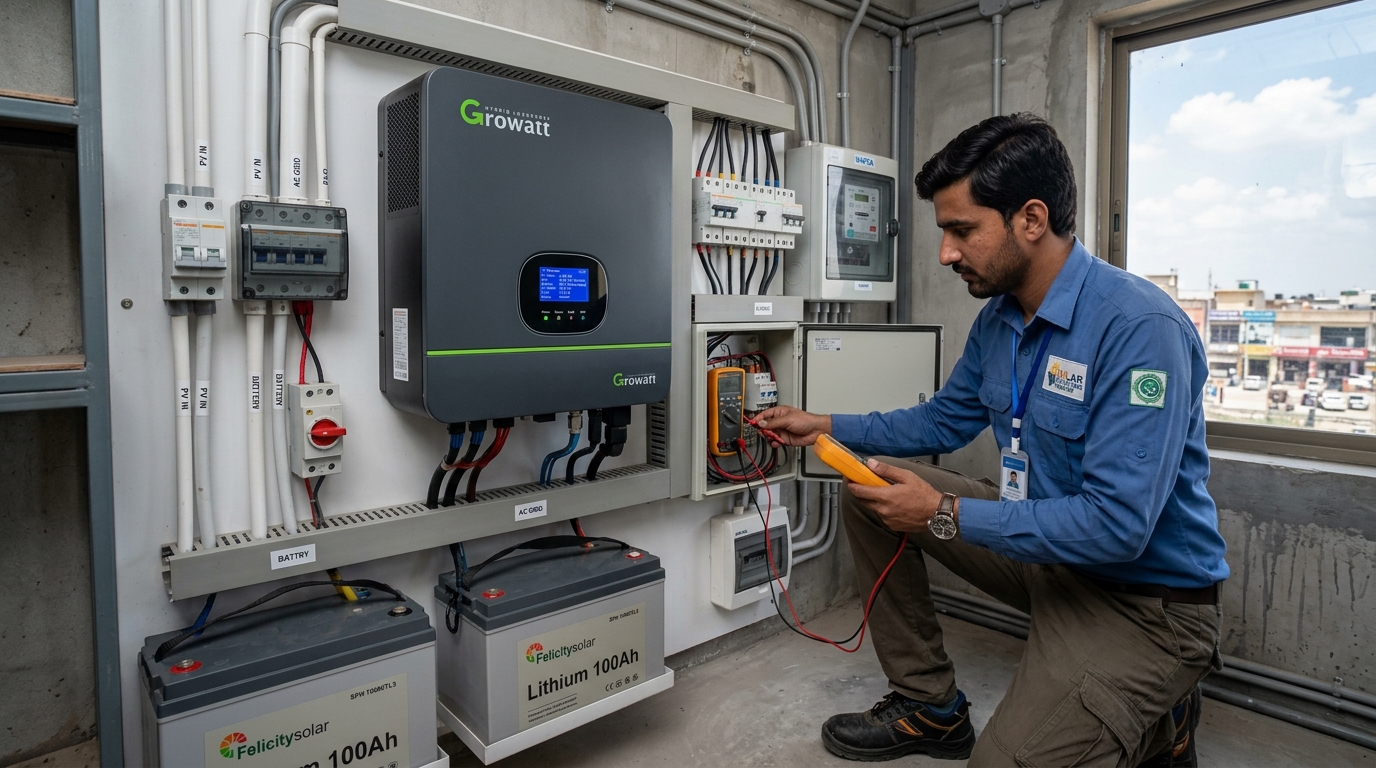
- Your system instantly transitions into full bi-directional net metering mode without rewiring a single cable!
6. Current Transformer (CT) Orientation, Polarity Testing & Multi-Inverter Topology
Successful zero export operation depends entirely on the accuracy, sampling frequency, and correct directional alignment of the external Current Transformer (CT) sensors or RS485 smart energy meters (such as Eastron SDM630 or Chint DTSU666). An inverted CT clamp or phase misalignment instantly confuses the anti-reverse control algorithm, leading to unintentional grid backfeed or excessive solar throttling.
Adhere to this rigorous commissioning protocol when setting up your zero export system:
- CT Arrow Polarity Verification: Every commercial split-core CT sensor is labeled with an arrow showing the required direction of current flow (or marked with source P1 and load P2 terminals). The arrow must face directly toward the household electrical loads (away from the incoming utility meter). If oriented in reverse, the inverter mistakes incoming utility power for solar export and shuts down generation.
- Strict Phase Matching (L1, L2, L3): In 3-phase 400V electrical installations, verify with a phase rotation indicator that Phase L1 (Red), Phase L2 (Yellow), and Phase L3 (Blue) on the incoming utility circuit breaker strictly match terminals L1, L2, and L3 on the smart energy meter and inverter AC terminals. A 120-degree phase transposition produces negative vector calculations, disabling export control.
- Ultra-Fast Modbus Polling (Under 200ms): Ensure RS485 communication operates at 9600 to 19200 baud with refresh intervals under 200 milliseconds. When an inductive domestic load—such as an inverter compressor or water pump—suddenly shuts off, the zero-export controller must ramp down solar inverter generation within 1 to 2 seconds to avoid transient back-feeding into mechanical utility meters.
- Multi-Inverter Master-Slave Communication: On commercial rooftops with multiple string inverters, wire an industrial data logger (such as Huawei SmartLogger or Solarman Smart Logger) as the Modbus Master. The logger aggregates real-time site power and dynamically throttles generation across all connected inverters in balanced unison.
Following strict phase conventions and rapid modbus communication protocols eliminates utility reverse-power penalties while maximizing your solar self-consumption savings.
7. Frequently Asked Questions (FAQ)
Q1: Does a Zero Export Device damage solar panels by throttling generation?
No. Solar cells simply operate at their open-circuit voltage (Voc) when throttled. Photons hitting the glass are dissipated as harmless radiant ambient heat, exactly like an unplugged solar panel sitting in the sun.
Q2: Can I use a Zero Export Device on a Three-Phase house?
Yes. Three-phase systems require a 3-Phase Smart Energy Meter (such as the Eastron SDM630 Modbus V2) with 3 separate CT clamps monitoring all three phases (Red, Yellow, Blue) simultaneously.
Q3: Will a Zero Export Device function during grid load shedding?
In standard grid-tied solar systems without battery storage, zero export limiters will shut down alongside the inverter during utility outages to comply with mandatory anti-islanding regulations. If continuous daytime backup power during grid cuts is required, you must install a hybrid inverter paired with a battery bank.
Q4: How quickly does the zero export limiter respond to sudden load changes?
Modern RS485 smart meters sample power consumption every 150 to 200 milliseconds and update inverter output within 1 to 2 seconds. When heavy appliances like air conditioners turn off, this rapid response prevents transient solar export into the utility meter.
Need to check or calculate your current utility bill?
Verify your electricity duplicate bill with instant photo-reading verification or calculate slab costs accurately.