Net Metering New Policy Pakistan 2026: Pakistan’s solar energy sector has entered a new phase in 2026. After years of rapid growth in rooftop solar installations, the government and the National Electric Power Regulatory Authority (NEPRA) introduced major reforms that have transformed the way solar consumers interact with the national grid. The most significant development is the gradual transition from the traditional net metering model to a net billing or prosumer-based framework. This change has generated widespread debate among homeowners, businesses, solar companies, and energy experts.
Net Metering New Policy Pakistan 2026
The government argues that the previous system created a growing financial burden on conventional electricity consumers. Officials claim that as more affluent households adopted solar systems, the cost of maintaining the national grid was increasingly shifted to consumers who did not have solar installations. According to government statements, policymakers considered regulatory reform necessary to maintain the long-term sustainability of Pakistan’s electricity sector.
For ordinary Pakistanis, however, the discussion is much simpler. People want to know whether solar is still profitable, whether net metering has ended completely, and whether investing in solar panels in 2026 still makes financial sense. This comprehensive guide answers all of those questions while explaining the latest policy developments in simple language. Net Metering New Policy Pakistan 2026
What Is Net Metering?
Net metering is a billing mechanism that allows solar system owners to export surplus electricity to the national grid and receive credits in return. Think of the national grid as a giant battery. During the day, when solar panels generate more electricity than a household consumes, excess power is sent to the grid. At night or during cloudy periods, consumers draw electricity back from the grid. Net Metering New Policy Pakistan 2026
Under Pakistan’s original net metering framework introduced through NEPRA regulations, exported units could effectively offset imported units. This made rooftop solar highly attractive because consumers could significantly reduce their monthly electricity bills. Many households achieved near-zero electricity bills after installing properly sized solar systems.
How Traditional Net Metering Worked
Under the older arrangement, electricity exported to the grid was credited at rates closely linked to the National Average Power Purchase Price. Consumers enjoyed a favorable compensation structure, making solar installations financially rewarding. A family generating surplus electricity during daylight hours could use those credits later when solar generation dropped. Net Metering New Policy Pakistan 2026
The attractiveness of this model led to a dramatic increase in solar adoption across Pakistan. Falling solar panel prices, rising electricity tariffs, and growing concerns about load shedding encouraged homeowners and businesses to invest heavily in rooftop solar systems. By late 2024, net-metering consumers had grown to approximately 283,000 with installed capacity exceeding 4,100 MW. Net Metering New Policy Pakistan 2026
Benefits for Residential Consumers
The original net metering system offered several advantages. First, it dramatically reduced electricity bills. Second, it improved the return on investment for solar systems. Third, it encouraged renewable energy adoption and reduced dependence on imported fuels. Many households recovered their solar investment within four to five years and then enjoyed years of relatively free electricity. Net Metering New Policy Pakistan 2026
The system also contributed to environmental sustainability by encouraging clean energy generation. Every rooftop solar installation reduced demand for electricity generated from fossil fuels, helping lower carbon emissions and improving energy security. Net Metering New Policy Pakistan 2026
Why the Government Changed the Policy
The government maintains that policy reform became necessary due to the explosive growth of solar energy installations. Solar panel prices dropped sharply in recent years, making rooftop systems affordable for a larger segment of the population. As more consumers generated their own electricity, demand from the national grid declined. Net Metering New Policy Pakistan 2026
Rising Number of Solar Users
Pakistan witnessed one of the fastest solar adoption rates in the region. Industry reports indicate that large volumes of solar panels entered the country, and rooftop installations became common in residential, commercial, agricultural, and industrial sectors. The rapid growth exceeded many government projections and forced policymakers to reconsider the economics of electricity distribution. Net Metering New Policy Pakistan 2026
Financial Burden on Grid Consumers
Government officials argue that net metering created cross-subsidization issues. According to the Power Division, solar consumers reduced their contribution toward fixed grid costs while continuing to rely on the grid as backup infrastructure. Authorities estimated that the burden transferred to non-solar consumers had reached significant levels and could rise dramatically if the policy remained unchanged. The ECC specifically cited these concerns when approving amendments to the regulations.
Supporters of reform believe that a revised system creates a fairer balance between solar users and traditional electricity consumers. Critics, however, argue that the government should encourage renewable energy rather than reduce incentives. Net Metering New Policy Pakistan 2026
Major Changes in Net Metering Policy 2026
The most important aspect of the 2026 reforms is the replacement of traditional net metering with a new framework centered on net billing and prosumer regulations.
Shift from Net Metering to Net Billing
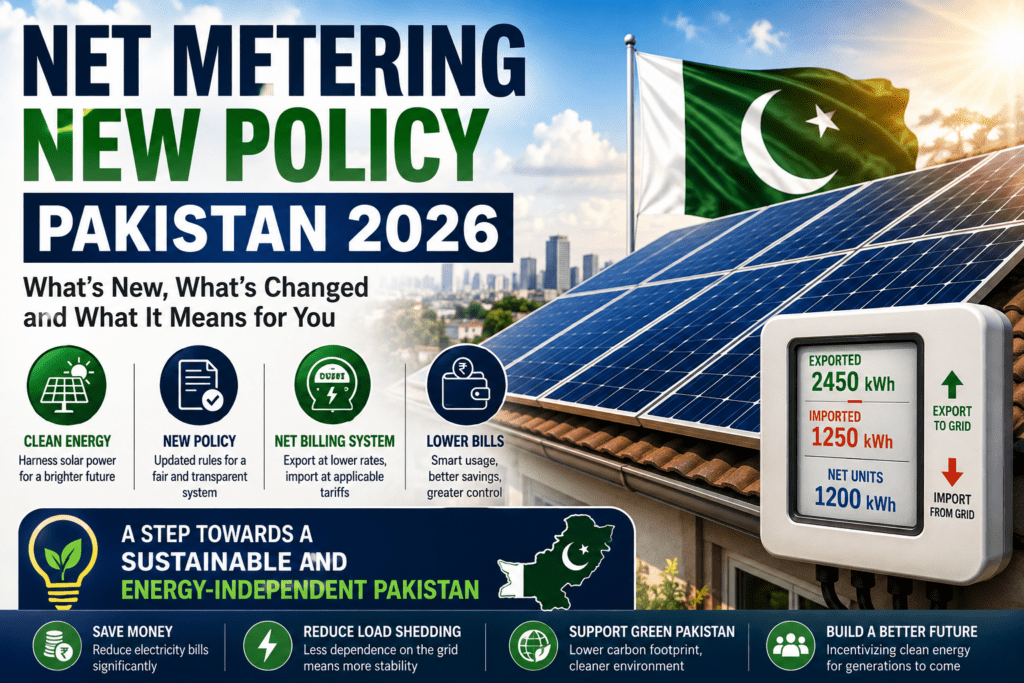
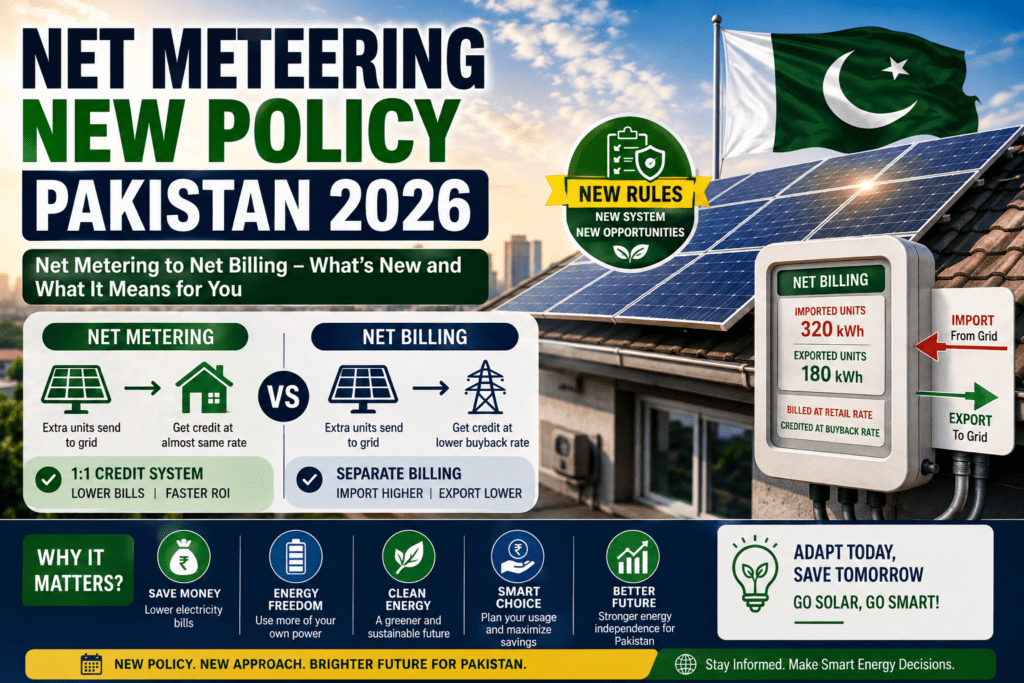
The biggest change is the move away from the classic 1:1 credit structure. Under the new framework, imported and exported electricity are treated separately. Consumers buy electricity from the grid at retail rates while selling surplus electricity back at a lower buyback rate. This fundamentally changes the economics of solar investments.
Revised Buyback Rate
In 2025, the Economic Coordination Committee approved amendments reducing the buyback rate to approximately Rs. 10 per unit, while allowing future revisions by NEPRA. Subsequent discussions surrounding the 2026 framework have generally referenced buyback rates in the range of Rs. 9 to Rs. 11 per unit for new applicants.
Changes in Contract Duration
Reports associated with the new prosumer regulations indicate that agreement durations have been reduced from seven years to five years for new arrangements. This change gives regulators greater flexibility to adjust policies according to future market conditions.
Separate Billing for Import and Export Units
Consumers now face a different accounting structure. Electricity imported from the grid is billed at applicable retail tariffs, including taxes and surcharges. Exported electricity is compensated separately at the approved buyback rate. This means consumers no longer enjoy the same level of offsetting benefits available under traditional net metering.
Comparison Between Old and New System
Net Metering vs Net Billing Table
| Feature | Old Net Metering | New Net Billing 2026 |
|---|---|---|
| Export Credit | Near retail-linked value | Approx. Rs. 9–13/unit |
| Import Billing | Offset by exports | Billed separately |
| Unit Exchange | Effectively 1:1 | Not 1:1 |
| Contract Duration | 7 Years | 5 Years |
| ROI on Solar | Faster | Slower |
| Battery Importance | Moderate | High |
| Consumer Savings | Very High | Moderate |
This table clearly shows why many consumers perceive the new policy as less favorable. The difference between buying electricity at retail rates and selling it back at significantly lower rates directly impacts financial returns.
Impact on Existing Solar Users
One of the biggest concerns among solar owners was whether existing agreements would be canceled. Government officials repeatedly stated that consumers with valid agreements signed under previous regulations would continue to enjoy protections under those agreements. Multiple official statements emphasized that existing contracts would not be immediately affected by the revised framework.
This protection is often referred to as “grandfathering.” It means people who invested under older rules are generally allowed to continue receiving benefits associated with their existing contracts until those agreements expire. This approach helps preserve investor confidence and reduces legal uncertainty.
For many households, this is welcome news because solar investments often involve significant upfront expenditures. Consumers who made decisions based on previous regulations would understandably be concerned if those rules changed overnight.
Impact on New Solar Consumers
New applicants face a very different environment. Since exported electricity receives a lower compensation rate, overall financial returns are reduced compared to earlier years.
Return on Investment Changes
Under the old system, many residential solar projects achieved payback periods of four to five years. Under the new net billing framework, the payback period may extend depending on system size, household consumption patterns, electricity tariff trends, and battery usage.
Consumers who export large amounts of electricity during the day will notice the greatest impact because surplus power now earns significantly less compensation. The key strategy in 2026 is maximizing self-consumption rather than maximizing exports.
Payback Period Analysis
Consider a homeowner with a 10-kW solar system. Under older regulations, excess electricity exported during daylight hours generated valuable credits. Under the new framework, those exports may receive compensation around Rs. 9–11 per unit, while imported electricity could cost several times more. As a result, consumers achieve the best savings when they use their solar-generated electricity directly rather than sending it to the grid.
This shift encourages smarter energy management and greater interest in battery storage solutions.
Benefits of the New Policy
Although the policy has faced criticism, supporters identify several advantages. Government officials believe the reforms help maintain grid sustainability and reduce cross-subsidization between solar and non-solar consumers. They argue that a balanced framework ensures the electricity system remains financially viable as renewable energy adoption increases.
The policy also encourages technological innovation. Consumers are increasingly exploring battery storage, energy management systems, and optimized consumption patterns. Instead of relying solely on exports, households are learning how to store and use solar energy more efficiently.
From a broader perspective, regulators hope the reforms will create a more predictable and sustainable electricity market. Energy planners believe that aligning compensation with actual energy purchase costs better reflects economic realities.
Challenges and Criticism
The strongest criticism revolves around reduced financial incentives for rooftop solar investments. Many industry stakeholders argue that lowering compensation rates discourages renewable energy adoption and weakens investor confidence.
Solar companies have expressed concerns that reduced returns could slow market growth. Consumers who were planning installations may postpone decisions while evaluating the financial impact of the new rules. Some analysts fear that policy uncertainty could negatively affect long-term investment in distributed renewable energy.
Critics also argue that rooftop solar helps reduce pressure on the national grid during peak daylight hours. From this perspective, solar users provide value to the electricity system and should receive stronger incentives rather than reduced compensation.
The debate remains highly active because both sides present legitimate arguments. Policymakers seek grid stability, while consumers seek attractive investment returns.
Role of Batteries Under the New Rules
Battery storage has become one of the most important topics in Pakistan’s solar industry. Under traditional net metering, the grid effectively acted as a free storage system. Consumers exported surplus electricity during the day and recovered value later.
The new framework changes that calculation dramatically. Since exported electricity earns less compensation, storing electricity for personal use becomes more attractive. Reports already indicate increasing interest in battery systems following the introduction of the revised regulations.
Imagine filling a water tank instead of selling water at a very low price and buying it back later at a much higher price. That analogy perfectly captures why batteries are gaining popularity. Homeowners can store excess solar energy during the day and use it during evening hours when electricity demand is highest.
As battery prices continue to decline globally, integrated solar-plus-storage systems may become the preferred solution for many Pakistani households.
Future of Solar Energy in Pakistan
Despite policy changes, the future of solar energy in Pakistan remains promising. Electricity prices remain high, sunlight availability is excellent, and energy security continues to be a national priority. These factors create strong incentives for ongoing solar adoption.
Pakistan has already emerged as one of the world’s fastest-growing solar markets. Massive imports of solar equipment and increasing consumer awareness suggest that demand will continue, even if growth patterns change under the new regulatory environment.
The market may evolve from simple rooftop systems toward more sophisticated solutions involving batteries, smart inverters, energy management software, and hybrid backup systems. Consumers are likely to focus on maximizing self-consumption rather than maximizing exports.
Over time, policymakers may continue refining regulations as technology evolves and grid conditions change. Flexibility will remain essential because the energy landscape is transforming rapidly.
Expert Opinions and Industry Response
Energy experts remain divided. Some believe the reforms are necessary to prevent financial imbalances within the electricity system. Others argue that reducing solar incentives risks slowing Pakistan’s transition toward cleaner energy.
Government representatives maintain that net metering has not been abolished entirely but has been transformed into a more sustainable and transparent model. Industry stakeholders, meanwhile, continue advocating for policies that preserve strong incentives for distributed renewable energy.
A growing consensus is emerging around one point: batteries will play a much larger role in the future. Whether consumers support or oppose the reforms, many acknowledge that energy storage technologies will become increasingly important under the new framework.
Should You Install Solar in 2026?
The short answer is yes—but with different expectations.
Solar remains one of the best ways to reduce electricity expenses in Pakistan. However, the strategy has changed. Under the old system, exporting electricity was highly rewarding. Under the new system, success depends on consuming as much solar power as possible within your home or business.
If you are planning a solar installation in 2026, focus on proper system sizing. Oversized systems that generate excessive exports may not deliver optimal returns. Instead, systems designed around actual consumption patterns often produce better financial outcomes.
Consumers considering battery storage should also evaluate long-term economics. While batteries increase upfront costs, they may significantly improve overall savings under the net billing framework.
The key takeaway is simple: solar is still valuable, but smart system design matters more than ever before.
Conclusion
Pakistan’s Net Metering New Policy 2026 represents one of the most significant energy-sector reforms of recent years. The transition from traditional net metering to net billing has changed how solar consumers earn value from surplus electricity. Lower buyback rates, separate import-export billing, and revised contract structures have altered the economics of rooftop solar installations.
Existing consumers generally retain important protections under previously signed agreements, while new applicants must adapt to the realities of the new framework. Although returns may be lower than before, solar energy remains a highly attractive investment due to Pakistan’s abundant sunshine, rising electricity costs, and growing demand for energy independence.
The future belongs to consumers who combine solar generation with intelligent energy management and battery storage solutions. Those who adapt to the new environment are likely to continue benefiting from clean, affordable, and reliable electricity for years to come.
FAQs
1. Has net metering been completely abolished in Pakistan?
The traditional model has largely been replaced by a net billing/prosumer framework for new applicants, though protections remain for many existing agreements.
2. What is the new buyback rate in 2026?
Reports and official discussions indicate a buyback rate generally around Rs. 9–11 per unit for new consumers, subject to regulatory revisions.
3. Are existing solar users affected?
Government statements indicate that existing consumers with valid agreements retain protections under their current arrangements.
4. Is solar still worth installing in Pakistan?
Yes. Solar remains financially beneficial, especially when systems are designed to maximize self-consumption rather than exports.
5. Should I install batteries with my solar system?
Battery storage has become increasingly attractive because exported electricity receives lower compensation than before, making self-consumption more valuable.