10kW Solar System Net Metering Pakistan 2026: Electricity prices in Pakistan continue to increase every year, making solar energy one of the smartest investments for homeowners and businesses. Among all residential solar options, the 10kW solar system has become one of the most popular choices because it provides enough electricity for large homes, offices, schools, and small commercial buildings. It can significantly reduce electricity bills while also helping users become less dependent on the national grid.
10kW Solar System Net Metering Pakistan 2026
The solar market in Pakistan has changed considerably in 2026 due to updated NEPRA regulations. The biggest change is the move from the traditional net metering model to the newer net billing/prosumer framework for many new installations. This means exported electricity is no longer credited on the same one-to-one basis as before, and compensation rates for new connections are different from older agreements. Existing users generally remain protected according to the terms of their approved agreements, while new applicants should carefully understand the latest policy before investing. 10kW Solar System Net Metering Pakistan 2026
This complete guide explains everything you need to know about a 10kW Solar System in Pakistan (2026), including its price, electricity production, savings, installation process, maintenance requirements, and the latest net metering policy updates. 10kW Solar System Net Metering Pakistan 2026
What is a 10kW Solar System?
A 10-kilowatt solar system is a photovoltaic (PV) system capable of generating approximately 10,000 watts of electricity under ideal sunlight conditions. Depending on the panel wattage, it typically uses around 18–24 high-efficiency solar panels. 10kW Solar System Net Metering Pakistan 2026
A properly installed 10kW system is suitable for:
- Large homes
- Villas
- Farmhouses
- Offices
- Clinics
- Schools
- Small businesses
Under Pakistan’s climate, which enjoys abundant sunshine throughout the year, a quality 10kW system can produce approximately 35–50 kWh (units) of electricity per day, depending on location, weather, and system efficiency. 10kW Solar System Net Metering Pakistan 2026
Its popularity comes from its ability to handle multiple air conditioners, refrigerators, washing machines, water pumps, computers, and other household appliances simultaneously.
How Net Metering Works in Pakistan
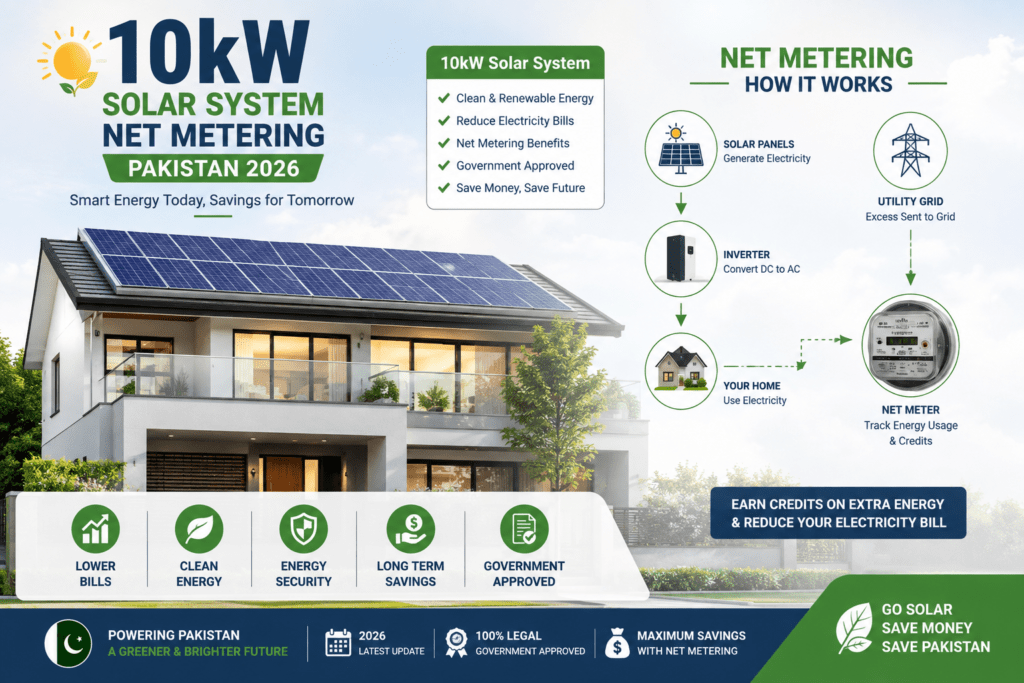
Net metering allows consumers to export excess electricity generated by their solar system to the national electricity grid. 10kW Solar System Net Metering Pakistan 2026
When your solar panels generate more electricity than your home consumes during the daytime, the surplus power is sent to the grid. At night or during cloudy weather, electricity is imported back from the grid. 10kW Solar System Net Metering Pakistan 2026
Difference Between Net Metering and Net Billing (2026)
Pakistan’s regulatory framework has evolved in 2026. New connections are generally subject to the Prosumer Regulations, which shift many applicants from the traditional 1:1 unit-offset net metering model to a net billing approach. Under this framework, exported electricity is credited at a lower approved purchase rate rather than directly offsetting imported units at retail tariffs. Existing approved agreements may continue to receive transitional protections according to their contract terms.
| Feature | Traditional Net Metering | Net Billing (2026) |
|---|---|---|
| Export Credit | Unit-based offset | Monetary credit |
| Export Rate | Higher historical benefit | Lower approved rate for new users |
| Import Rate | Retail tariff | Retail tariff |
| Best For | Older approved systems | New applications under current rules |
Latest NEPRA Rules for 2026
Recent regulatory changes include:
- New solar applicants are generally processed under updated Prosumer Regulations.
- Export compensation for new systems is lower than historical net metering arrangements.
- Existing agreements may retain transitional benefits until contract expiry.
- Technical approvals and DISCO requirements remain mandatory before grid interconnection.
Components of a 10kW Solar System
A 10kW solar system is made up of several important components that work together to convert sunlight into usable electricity. Choosing high-quality equipment ensures better performance, higher efficiency, and a longer system lifespan. Although the solar panels receive the most attention, every component plays an essential role in delivering reliable power. 10kW Solar System Net Metering Pakistan 2026
Solar Panels
Solar panels are the heart of the system. In 2026, most installers in Pakistan use N-Type TOPCon or Mono PERC panels because they offer higher efficiency than older technologies. Depending on the manufacturer and wattage, a 10kW system generally requires 18 to 24 panels. For example, using 550W panels requires around 19 panels, while 450W panels require approximately 22 panels. 10kW Solar System Net Metering Pakistan 2026
Modern Tier-1 brands available in Pakistan include LONGi, JA Solar, Jinko Solar, Canadian Solar, Trina Solar, and Astronergy. These panels usually come with a 25 to 30-year performance warranty, ensuring they continue producing electricity efficiently for decades. High-quality panels also perform better during cloudy weather and high temperatures, making them suitable for Pakistan’s climate. 10kW Solar System Net Metering Pakistan 2026
Solar Inverter
The inverter is often called the brain of the solar system because it converts the DC electricity generated by the solar panels into AC electricity used by household appliances. Without a reliable inverter, the electricity produced by the panels cannot be used effectively.
There are three common inverter types:
- On-Grid Inverter: Works with the electricity grid and supports net metering or net billing.
- Hybrid Inverter: Can work with batteries while also remaining connected to the grid.
- Off-Grid Inverter: Designed for locations without a utility connection.
Popular inverter brands in Pakistan include Huawei, Growatt, GoodWe, Solis, Sungrow, Fronius, and Inverex. A high-quality inverter can operate efficiently for 10–15 years with proper maintenance.
Mounting Structure
The mounting structure securely holds the solar panels on the roof. Most professional installers use hot-dip galvanized steel or high-grade aluminum structures that resist rust and corrosion. A properly designed structure can withstand strong winds, heavy rainfall, and extreme temperatures while maintaining the correct angle for maximum sunlight exposure.
Roof orientation also affects electricity production. In Pakistan, south-facing installations generally provide the best annual performance, although east-west configurations may be used depending on roof design.
Protection Equipment
Safety equipment is just as important as the panels and inverter. A complete 10kW installation usually includes:
- DC isolators
- AC breakers
- Surge protection devices
- Earthing system
- Lightning protection (where required)
- High-quality DC and AC cables
These components protect both the solar system and household electrical appliances from electrical faults and power surges.
10kW Solar System Price in Pakistan 2026
The price of a 10kW solar system depends on several factors, including panel brand, inverter quality, mounting structure, installation charges, and whether batteries are included. Exchange rates and import duties also influence the final cost because many solar components are imported.
Estimated Price Range (2026)
| System Type | Estimated Price (PKR) |
|---|---|
| On-Grid 10kW | 1,150,000 – 1,450,000 |
| Hybrid 10kW | 1,500,000 – 1,900,000 |
| Hybrid with Battery Backup | 2,200,000 – 3,200,000 |
Prices are approximate and vary by city, equipment brand, installation company, and market conditions.
Although the initial investment may seem significant, the system can provide electricity for more than 25 years, making it one of the most cost-effective long-term energy solutions.
Factors Affecting the Price
Several factors influence the overall project cost:
- Quality and efficiency of solar panels
- Type of inverter
- Roof size and installation complexity
- Mounting structure material
- Wiring and protection equipment
- Net billing approval process
- Battery backup (if selected)
Choosing cheaper components may reduce the initial cost but can result in lower efficiency, reduced energy production, and higher maintenance expenses over time.
Monthly Electricity Production
Pakistan receives excellent solar irradiation throughout the year, allowing a 10kW system to generate substantial electricity.
Average Daily Generation
Depending on the city and weather conditions, a 10kW system can produce:
| City | Daily Units |
|---|---|
| Lahore | 38–48 |
| Islamabad | 36–46 |
| Karachi | 40–50 |
| Faisalabad | 38–47 |
| Multan | 40–50 |
| Peshawar | 37–46 |
Monthly Production
Average monthly production typically ranges between:
1,100 and 1,500 units (kWh)
Production varies depending on:
- Dust accumulation
- Seasonal weather
- Roof angle
- Panel orientation
- Shading from nearby buildings or trees
Regular cleaning can improve annual production by several percentage points.
Monthly Savings
One of the biggest reasons homeowners invest in solar energy is the potential to reduce electricity bills.
A household consuming around 1,200 to 1,500 units per month can significantly lower grid electricity purchases with a properly sized 10kW system. Actual savings depend on:
- Daytime electricity consumption
- Local utility tariff
- Seasonal sunshine
- Export compensation under the current net billing framework
Homes that use more electricity during daylight hours generally benefit the most because they consume their own solar power directly rather than exporting it.
Return on Investment (ROI)
Even after recent policy changes, solar remains an attractive investment because electricity tariffs continue to rise over time.
For many households:
- Estimated payback period: 4–7 years (depending on usage, tariffs, and financing).
- Expected system life: 25–30 years.
- Long-term savings: Potentially several million Pakistani Rupees over the system’s lifetime, assuming continued electricity price increases and proper maintenance.
After the initial investment is recovered, most of the electricity generated is effectively free, aside from routine maintenance and any future inverter replacement.
FAQs
1. How much does a 10kW solar system cost in Pakistan in 2026?
The average price of a 10kW solar system in Pakistan ranges from PKR 1.15 million to PKR 1.45 million for an on-grid system. A hybrid system typically costs PKR 1.5 million to PKR 1.9 million, while a hybrid system with battery backup can range from PKR 2.2 million to PKR 3.2 million. The final price depends on the quality of solar panels, inverter brand, mounting structure, installation charges, and the city where the system is installed.
2. How many units of electricity does a 10kW solar system produce per day?
A properly installed 10kW solar system can generate approximately 35 to 50 kWh (units) of electricity per day, depending on the location, weather conditions, panel efficiency, and sunlight hours. On average, the system produces around 1,100 to 1,500 units per month, which is sufficient for many large homes and small businesses in Pakistan.
3. Is net metering still available in Pakistan in 2026?
Pakistan has introduced updated Prosumer Regulations in 2026. While existing approved net metering users may continue under their existing agreements, new applicants are generally processed under the net billing (prosumer) framework. Under this system, exported electricity is compensated according to the approved purchase rate rather than offsetting imported units on a one-to-one basis. Before installing a system, it is advisable to confirm the latest policy with your local DISCO and NEPRA guidelines.
4. How many solar panels are required for a 10kW solar system?
The number of panels depends on the wattage of each solar panel. Modern systems usually require:
19 panels of 550W
18 panels of 580W
22 panels of 450W
Most installations in Pakistan use high-efficiency N-Type TOPCon or Mono PERC panels from reputable Tier-1 manufacturers for better long-term performance.
5. Is a 10kW solar system enough for a large house?
Yes. A 10kW solar system is ideal for large houses with high electricity consumption. It can comfortably power multiple air conditioners, refrigerators, washing machines, LED lighting, water pumps, televisions, computers, kitchen appliances, and other household electronics. It is generally recommended for homes consuming 1,000 to 1,500 electricity units per month, although the exact suitability depends on your daily energy usage patterns.
6. What is the lifespan of a 10kW solar system?
Most Tier-1 solar panels have a lifespan of 25 to 30 years and typically come with long-term performance warranties. Inverters usually last 10 to 15 years, while mounting structures can last over 25 years with proper maintenance. Regular cleaning and periodic inspections help maximize system performance and longevity.
7. How long does it take to recover the investment?
The average payback period for a 10kW solar system in Pakistan is approximately 4 to 7 years, depending on installation cost, electricity tariffs, energy consumption, and the applicable net billing or net metering arrangement. After recovering the initial investment, the system can continue generating low-cost electricity for many years.
8. Does a 10kW solar system work during a power outage?
An on-grid solar system automatically shuts down during a power outage for safety reasons and will not supply electricity unless paired with battery backup and a compatible hybrid inverter. If uninterrupted power during load shedding is important, consider installing a hybrid solar system with batteries.
9. How much roof space is needed for a 10kW solar system?
A standard 10kW solar system generally requires 500 to 700 square feet (46–65 square meters) of shadow-free roof space. The exact area depends on the size and efficiency of the solar panels used and the layout of the roof.
10. Is a 10kW solar system worth installing in 2026?
Yes. Despite changes to Pakistan’s solar export policy, a 10kW solar system remains a worthwhile investment for households and businesses with high daytime electricity consumption. By using more of the solar power you generate, you can significantly reduce electricity bills, protect yourself from rising energy costs, and enjoy a reliable, environmentally friendly source of electricity for decades.