billsonlinepk.com

Bijli Bill — Check Electricity Bills Online Pakistan
ALL 11 DISCOS · FREE · NO LOGIN NEEDED

Check Electricity Bills Online Pakistan

Instantly check duplicate electricity bills for MEPCO, LESCO, FESCO, IESCO, GEPCO, HESCO, PESCO, QESCO, SEPCO, TESCO, HAZECO, and K-Electric (KE). View, download, and print your bill using your reference number or customer ID.

MEPCOLESCOFESCOIESCOGEPCO HESCOPESCOQESCOSEPCOTESCO HAZECOK-ELECTRIC
Official billing data
100% free
📱 Mobile friendly
🔒 No account required
Check Your Bill Now
Select your distribution company to begin
Distribution Company
Reference Number
Printed on top of your physical bill 0 / 14 digits entered
Please enter a valid reference number to continue.

Opens your DISCO's official PITC bill portal in a new tab.

                                                                                                MEPCO Service Coverage: A Detailed Overview

The Multan Electric Power Company, widely known by its acronym MEPCO, stands as the largest electricity distribution company (DISCO) in Pakistan in terms of geographical coverage. Headquartered in the city of Multan, MEPCO supplies electricity to thirteen administrative districts across South Punjab, a region that includes Multan, Bahawalpur, Bahawalnagar, Rahim Yar Khan, Dera Ghazi Khan, Rajanpur, Muzaffargarh, Layyah, Vehari, Khanewal, Sahiwal, Pakpattan, and Lodhran. Multan itself serves not only as the company’s administrative headquarters but also as the commercial and logistical hub of the entire South Punjab region.

Historical Background

MEPCO’s roots trace back to 1922, when it operated under British colonial rule as the Multan Power Supply Company. Following independence, the company underwent nationalization in 1972 and came under the direct control of the Government of Pakistan. Interestingly, the company was once publicly listed on the Karachi Stock Exchange, though it was delisted in 1985. The modern incarnation of MEPCO came into existence on 14 May 1998, when the Government of Pakistan initiated the corporatization of the national energy sector. As part of this restructuring, MEPCO was established to take over all properties, rights, assets, obligations, and liabilities of the former Multan Area Electricity Board, along with its grid stations and transmission infrastructure.

Scale and Reach

Today, MEPCO serves somewhere between 7 and 7.5 million registered consumers, with the broader population benefiting from its services estimated at around 34 to 35 million people. In terms of sheer geography, MEPCO’s operational territory spans approximately 97,358 square kilometers, making it the single largest distribution company in the country by area covered. This vast territory is far larger than that of most other DISCOs operating in Pakistan, which is a direct consequence of South Punjab’s expansive and largely rural landscape.

To manage a network of this scale, MEPCO has organized its operations into a hierarchical structure consisting of 9 operational circles, 38 divisions, and 181 subdivisions. Each circle oversees a cluster of divisions, and each division in turn manages several subdivisions, allowing the company to maintain localized oversight of grid stations, feeders, and consumer services across such a wide and diverse territory. This layered administrative model helps MEPCO handle everything from routine maintenance to fault reporting and new connection requests at a manageable, localized level.

Infrastructure

MEPCO’s physical infrastructure reflects the scale of its coverage area. The company operates more than 150 grid stations, with a combined transformation capacity of roughly 7,500 MVA (megavolt-amperes). Its transmission and distribution network extends across tens of thousands of kilometers of lines — estimates place the figure between 66,000 and 82,000 kilometers depending on the source and year of measurement — supported by over 2,000 feeders that carry electricity from grid stations to the doorsteps of consumers. This extensive network is a continual work in progress, with MEPCO periodically adding new grid stations, transformers, and feeders to reduce voltage drops, tripping complaints, and unplanned outages, particularly in high-demand agricultural belts.

A Unique Geographic Position

One of the most distinctive aspects of MEPCO’s service territory is that it is the only Pakistani DISCO whose boundaries touch three different provinces and border five other distribution companies. Near Sadiqabad, MEPCO’s territory meets HESCO, which serves Sindh province. Close to Vahova, it borders PESCO, the distribution company for Khyber Pakhtunkhwa. Near Fort Munro, MEPCO’s territory touches QESCO’s jurisdiction in Balochistan. It also shares boundaries with FESCO near Bhakkar and with LESCO near Sahiwal. Adding to this geographic significance, MEPCO’s territory in the Minchinabad area of Bahawalnagar district actually extends to the international border with India. This combination of provincial and international boundary contact is unmatched by any other DISCO in the country.

Consumer Profile

Because MEPCO’s coverage area is predominantly rural and agricultural in character, its consumer base skews heavily toward domestic and lifeline (low-consumption) users, along with a substantial number of agricultural tube-well connections. Unlike more urbanized DISCOs such as LESCO or IESCO, which serve dense city populations with a higher proportion of commercial and industrial connections, MEPCO’s network must accommodate scattered rural feeders spread across vast farmland, which presents unique challenges in terms of line losses, maintenance costs, and outage management. The company categorizes its consumers into four broad groups — domestic, commercial, industrial, and agricultural — each billed according to tariff structures set by the National Electric Power Regulatory Authority (NEPRA).

Consumer Services

To make life easier for its millions of consumers, MEPCO has invested in a range of digital and remote-access services. These include online bill checking through the official PITC (Power Information Technology Company) portal, duplicate bill downloads, SMS-based bill inquiries, and an online complaint registration system. Complaints related to billing errors, low voltage, tripping, or unscheduled load shedding can be tracked through the Customer Complaint Management System (CCMS), which is shared across multiple DISCOs including MEPCO. The company also supports net metering for consumers who have installed solar panels, allowing surplus electricity generated at home to be fed back into the grid in exchange for billing credits — a service that has grown increasingly popular given Pakistan’s rising interest in renewable energy and rising conventional electricity costs.

Conclusion

In summary, MEPCO occupies a singular position within Pakistan’s power distribution landscape. It is not only the largest DISCO by geographical area but also one of the most administratively complex, given its nine circles, dozens of divisions, and nearly two hundred subdivisions spread across thirteen districts of South Punjab. Its unique position bordering three provinces and one foreign country, combined with a predominantly rural and agricultural consumer base, sets it apart from the more urban-focused distribution companies elsewhere in the country. For millions of residents across South Punjab, MEPCO is not just a utility provider but a critical piece of infrastructure underpinning agriculture, industry, and daily life across one of Pakistan’s largest and most populous regions.

             All Discos

                                                MEPCO-LESCO-FESCO IESCO-GEPCO-HESCO
PESCO-QESCO-SEPCO
TESCO-HAZECO
K-Electric.

                                                                                                     Trust & Transparency
                                                                                   Clear, honest, and easy to understand

                                           We give you access to the same official bill data used by millions of consumers, while making it clear who manages your electricity account (your DISCO) and who operates this website (us).


    Official Bill Information
Every duplicate bill is fetched from the official centralized billing platform. We never generate or alter bill amounts, tariff calculations, or due dates—only the official data is shown for your reference.

Simple Access, No Hassle
Forget passwords and paid subscriptions. With your printed reference number, you can retrieve your bill in just a few seconds from any internet connection.

Learn While You Check
Helpful guides on FPAs, tariff slabs, and payment processes are available alongside the bill checker, making it easier to understand your bill—not just view it.

Yahan MEPCO ke peak hours ki general table hai. Note: yeh timings season ke hisab se thori vary ho sakti hain, aur exact timing sirf official MEPCO/NEPRA notification ya aapke TOU meter tariff se confirm honi chahiye.

SeasonPeak HoursOff-Peak Hours
Summer (June–August)6:00 PM – 10:00 PM (kahin kahin 7 PM – 11 PM bhi report hui hai)Raat 11 PM se subah tak
Winter (December–February)5:00 PM – 9:00 PMDin/raat ke baqi hours
General/All-week6 PM – 10 PM (sabse zyada quoted window)Baaki poora din

Extra points jo useful hain:

  • Yeh peak hours har din (Monday se Sunday tak, including holidays) apply hoti hain.
  • Peak hours mein per-unit rate off-peak se kaafi zyada hota hai (kuch sources ke mutabiq roughly double).
  • Yeh schedule sirf TOU (Time of Use) ya TOD meter walon ke liye directly relevant hai — agar aapka simple meter hai to slab-based tariff apply hoga, peak/off-peak nahi.

Chunke yeh sab third-party/blog sources se hai (official MEPCO announcement nahi mila mujhe search mein), best hoga ke aap apna exact bill ya MEPCO ka official portal/customer service (118 helpline) check kar lein confirm timing ke liye.

MEPCO Net Metering Policy & Net Billing (2026 Update)

A complete guide for MEPCO (Multan Electric Power Company) solar consumers on the new NEPRA regulations, eligibility, application process, and rates.


What Changed in 2026?

On February 9, 2026, NEPRA officially notified the Prosumer Regulations 2026, replacing the older Net Metering Regulations 2015. This introduced a new Net Billing mechanism for new solar applicants, while existing net metering consumers retain their old terms until contract expiry.

Aspect Old System (Net Metering 2015) New System (Net Billing 2026)
Billing Mechanism 1:1 unit-for-unit exchange Two separate rates for import & export
Export (Sell) Rate Same as retail purchase rate (~Rs. 22–27/unit) National Average Energy Purchase Price (NAEPP) — approx. Rs. 10–11/unit
Import (Buy) Rate Standard MEPCO tariff Standard MEPCO tariff (Rs. 45–60/unit depending on slab)
Settlement Adjusted monthly against bill Surplus units settled/paid quarterly
Contract Duration Long-term (up to 7 years under later revisions) Capped at 5 years, renewable for another 5-year term
Applicability Existing contracts largely protected/honoured till expiry Applies to new applications only

Note: Following intervention at the federal level, NEPRA confirmed on February 16, 2026 that existing net metering agreements remain valid until their original expiry date and continue under the old unit-for-unit basis — only new connections fall under Net Billing.


Why the Policy Changed

  • Rooftop solar capacity in Pakistan crossed 6,000 MW, growing rapidly under the old 1:1 model.
  • DISCOs (including MEPCO) reported rising financial losses from buying back solar units at full retail rates.
  • Grid stability concerns emerged during peak solar generation hours.
  • NEPRA introduced Net Billing to make buyback rates reflect the actual average cost of power generation, rather than the retail tariff.

MEPCO Net Metering — Eligibility Criteria

Requirement Detail
Connection Type Residential, commercial, industrial, or agricultural (tube well) with active MEPCO connection
Phase Requirement Three-phase connection generally required
System Size Minimum 1 kW; must not exceed 1.5x sanctioned load
Sanctioned Load Must be equal to or greater than solar system capacity
Dues All previous MEPCO electricity dues must be cleared
Metering Hardware NEPRA/PEPCO-approved bi-directional (smart) meter
Installer AEDB-certified solar installer recommended/required
Safety Standard Inverter must have anti-islanding protection (UL 1741 / IEC 62116)

Rate Comparison (Approximate, 2026)

Item Old Net Metering New Net Billing
Buy-back (export) rate Rs. 22–27 / unit Rs. 10–11 / unit
Purchase (import) rate Rs. 37–55 / unit (slab-based) Rs. 45–60 / unit (slab-based)
Net Effect Oversized systems remained financially attractive Oversizing is less beneficial — best to size system close to actual consumption

Rates vary by consumer category and slab; always confirm current tariff via MEPCO or NEPRA’s official notification.


MEPCO Net Metering Application Process

  1. Submit Application — Apply through MEPCO’s online portal or your local sub-division office with CNIC, electricity bill, and property documents.
  2. Technical Feasibility Study — MEPCO reviews sanctioned load, wiring, and grid capacity.
  3. Demand Notice & Payment — Pay applicable fee for the bi-directional meter and connection charges.
  4. Solar System Installation — Installed by an AEDB-certified installer as per NEPRA technical standards.
  5. Inspection — MEPCO inspects the installation for safety and compliance.
  6. NOC (No Objection Certificate) — Issued after Punjab Energy Department clearance confirming compliance with SRO 892(I)/2015 and related regulations.
  7. Power Purchase Agreement (PPA) — Signed between the consumer (now a “prosumer”) and MEPCO.
  8. Bi-Directional Meter Installation — Final step; meter starts recording imported vs exported units.

Common Issues Faced by MEPCO Net Metering Consumers

  • Application processing delays
  • Bi-directional meter installation backlog
  • Billing mismatches between imported/exported units
  • Confusion between old vs new contract terms after the 2026 policy shift

Quick FAQs

Is net metering with MEPCO legal? Yes — it is fully regulated by NEPRA, and MEPCO operates under NEPRA’s official framework.

Will my existing net metering agreement change? No — contracts signed under the 2015 regulations remain valid on their original 1:1 terms until expiry.

What is the minimum/maximum system size for MEPCO net metering? Minimum 1 kW; maximum limited by sanctioned load (MEPCO processes up to 1 MW under the NEPRA Generation Licence Exemption framework).

How is surplus electricity paid under Net Billing? On a quarterly basis, at the National Average Energy Purchase Price, rather than monthly bill adjustment.

Where can I apply or get more information? Through your nearest MEPCO sub-division office or the MEPCO online portal; helpline for general queries is available via MEPCO customer service.


Disclaimer: Rates, timelines, and procedures are subject to change per NEPRA notifications. Always verify current details with your local MEPCO office or NEPRA’s official website before making investment decisions.

MEPCO Electricity Bills: Complete Guide 2026

Everything MEPCO (Multan Electric Power Company) consumers need to know — tariff slabs, bill components, how to check and pay your bill, and tips to reduce your monthly cost.


About MEPCO

MEPCO (Multan Electric Power Company) is the electricity distribution company serving South Punjab, including Multan, Bahawalpur, Sahiwal, DG Khan, Vehari, Khanewal, Lodhran, Muzaffargarh, Layyah, Rajanpur, and Bahawalnagar. Electricity rates for MEPCO are set by NEPRA (National Electric Power Regulatory Authority) under the Government of Pakistan.


MEPCO Residential Tariff Slabs (2026)

Consumer CategoryMonthly UsageApprox. Rate per Unit
Protected ConsumerUp to 200 units/monthRs. 5 – 14 / unit
Non-Protected ConsumerAbove 200 units/monthRs. 23 – 68 / unit (slab-based)

Important: If a “Protected” consumer crosses 200 units even once in a billing month, MEPCO reclassifies the entire month’s consumption under Non-Protected slab rates — not just the extra units. This is one of the most common reasons for a suddenly high bill.

Commercial, industrial, and agricultural (tube well) consumers have separate tariff categories (e.g., A-1, B, C, E series) with their own minimum monthly charges — some categories carry a minimum bill even with zero consumption.


What’s Included in a MEPCO Bill

A typical MEPCO bill has around 9–11 line items:

ComponentDescription
Energy ChargesUnits consumed × applicable slab rate
Fixed/Customer ChargesFlat monthly charge, applies regardless of usage in some categories
FPA (Fuel Price Adjustment)Variable monthly charge reflecting fuel cost used for generation; can be positive or negative
QTA (Quarterly Tariff Adjustment)Periodic adjustment reviewed by NEPRA every quarter
GST17% General Sales Tax
Electricity Duty1.5%, collected by the provincial government
NJ SurchargeAdditional regulatory surcharge (~10%)
TV License Fee (PTV Fee)Fixed Rs. 35/month
Meter RentSmall fixed charge for meter maintenance
Arrears / Deferred AmountAny unpaid previous balance or postponed installment

How to Check Your MEPCO Bill Online

You’ll need either your 14-digit Reference Number or 10-digit Customer ID, both printed on any previous bill.

  1. Visit MEPCO’s online bill portal (or an authorized bill-checking service).
  2. Enter your Reference Number or Customer ID.
  3. View your bill amount, due date, consumer name, address, and consumption details.
  4. Download or print the PDF — it’s accepted as a legally valid duplicate copy.

Check via SMS (no internet needed): Send PITC <space> <14-digit reference number> to 8334. You’ll receive the bill amount and due date within seconds.

SMS reminders: Register the same way to get an automatic alert ~10 days before your due date.


How to Pay Your MEPCO Bill

MethodHow
Mobile Wallets (Easypaisa, JazzCash, NayaPay, SadaPay)Open app → Bill Payment → Electricity → MEPCO → enter reference number → confirm
Mobile/Internet Banking (HBL, UBL, MCB, Meezan, Allied, etc.)Log in → Bill Payments/Utility → select MEPCO → enter reference number → pay
ATMInsert card → Bill Payments → MEPCO → enter reference number → follow prompts
Bank Branch / Post OfficePresent original or duplicate bill at the counter and pay in cash

Tip: Always save your transaction ID/screenshot. If a payment shows “pending” for more than 24 hours, contact your bank with this reference for follow-up.


Due Date Extensions

  • Bill amount under Rs. 100,000 → can request a 3-day extension
  • Bill amount over Rs. 100,000 → can request a 5-day extension

Extensions are typically requested through your nearest MEPCO sub-divisional office.


Peak Hours & Their Effect on Your Bill

Bills are higher when consumption happens during peak hours (typically 6 PM–10 PM, shifting to 5 PM–9 PM in winter for TOU/TOD meter consumers). See our detailed [MEPCO Peak Hours guide] for the full seasonal breakdown and rate comparison.


Common Reasons for a High MEPCO Bill

  • Crossing 200 units and losing “Protected” status for the whole month
  • Running heavy appliances (AC, iron, water heater) during peak hours
  • FPA/QTA increases passed on by NEPRA that particular quarter
  • Meter reading errors or estimated (not actual) readings
  • Unpaid arrears carried forward from a previous bill

Tips to Reduce Your MEPCO Bill

  1. Track usage regularly and try to stay within the 200-unit protected slab if you’re close to the line.
  2. Shift heavy appliance use (AC, washing machine, iron) outside peak hours.
  3. Use energy-efficient LED bulbs and inverter appliances.
  4. Consider net metering/solar if usage is consistently high (see our MEPCO Net Metering guide).
  5. Check your bill every month for reading errors or incorrect slab classification.

Quick FAQs

What is the 200-unit rule? Residential consumers using 200 units or less per month qualify as “Protected” and get lower slab rates. Exceeding 200 units in any month shifts the entire month’s bill to Non-Protected rates.

What is FPA on my bill? Fuel Price Adjustment — a variable monthly charge based on the fuel cost of electricity generation that month, set by NEPRA.

Can I check my bill without the internet? Yes, via SMS: send PITC <reference number> to 8334.

How do I get a duplicate bill copy? Enter your 14-digit reference number on MEPCO’s online portal and download the PDF — it’s valid for official use.

Does MEPCO use the same tariff as other DISCOs (LESCO, FESCO, etc.)? Yes, residential tariff slabs are set nationally by NEPRA, so base rates are generally consistent across DISCOs, though local surcharges can vary slightly.


Disclaimer: Tariff rates, taxes, and charges are set and periodically revised by NEPRA and are subject to change. Figures in this guide are approximate and for informational purposes — always confirm exact rates and charges via your official MEPCO bill or NEPRA’s website.

MEPCO Electricity Bills — FAQs (2026)

Q1: What is the 200-unit “Protected Consumer” rule? Residential consumers who use 200 units or less in a month are classified as “Protected” and billed at lower, subsidized slab rates. If usage crosses 200 units even once, the entire month’s consumption is billed at the higher Non-Protected rates — not just the extra units.

Q2: Why is my MEPCO bill suddenly so high this month? Common reasons include: crossing the 200-unit threshold and losing Protected status, running heavy appliances (AC, iron, water heater) during peak hours, a NEPRA-approved FPA or quarterly tariff increase, an estimated (not actual) meter reading, or arrears carried over from a previous unpaid bill.

Q3: What is FPA on my MEPCO bill? FPA stands for Fuel Price Adjustment — a variable monthly charge that reflects the actual cost of fuel used to generate electricity that month. It’s set by NEPRA and can increase or decrease your bill depending on the energy mix.

Q4: What is QTA (Quarterly Tariff Adjustment)? QTA is a periodic adjustment NEPRA applies every quarter to account for changes in the overall cost of electricity generation and distribution across the country.

Q5: What taxes and surcharges appear on a MEPCO bill? Typically: 17% GST, 1.5% Electricity Duty, an NJ Surcharge (~10%), and a fixed Rs. 35 TV License (PTV) fee, in addition to energy charges, fixed/customer charges, FPA, and QTA.

Q6: How can I check my MEPCO bill online? Enter your 14-digit Reference Number or 10-digit Customer ID on MEPCO’s online bill portal to view your bill amount, due date, and consumption details, and download a PDF copy.

Q7: Can I check my bill without internet access? Yes. Send PITC <space> <your 14-digit reference number> as an SMS to 8334 to get your bill amount and due date instantly.

Q8: How do I get a duplicate copy of my MEPCO bill? Enter your reference number on the MEPCO online portal and download the PDF — it’s accepted as a legally valid duplicate, identical to the original printed bill.

Q9: What are the easiest ways to pay my MEPCO bill? Mobile wallets (Easypaisa, JazzCash, NayaPay, SadaPay), mobile/internet banking apps (HBL, UBL, MCB, Meezan, Allied, etc.), ATMs, or in person at any bank branch or post office.

Q10: Can I get an extension on my due date? Yes. Bills under Rs. 100,000 are generally eligible for a 3-day extension, and bills over Rs. 100,000 for a 5-day extension. Extensions are requested through your nearest MEPCO sub-divisional office.

Q11: Do peak hours affect my MEPCO bill? Yes. Electricity used during peak hours (typically 6 PM–10 PM, or 5 PM–9 PM in winter) is billed at a significantly higher rate for TOU/TOD meter consumers. Shifting heavy appliance use to off-peak hours can noticeably lower your bill.

Q12: Does MEPCO charge the same tariff as LESCO, FESCO, or other DISCOs? Residential tariff slabs are set nationally by NEPRA, so base rates are broadly the same across DISCOs, though small differences in local surcharges may apply.

Q13: What happens if I don’t pay my MEPCO bill on time? A late payment surcharge is added, and your unpaid amount carries forward as arrears on the next bill. Continued non-payment can eventually lead to disconnection.

Q14: How can I reduce my monthly MEPCO bill? Stay within the 200-unit protected slab where possible, avoid heavy appliance use during peak hours, switch to energy-efficient LED lighting and inverter appliances, check your bill monthly for errors, and consider net metering/solar if your usage is consistently high.

Q15: Who regulates MEPCO’s electricity rates? NEPRA (National Electric Power Regulatory Authority), under the Government of Pakistan, approves and revises all MEPCO tariff rates, slabs, and periodic adjustments.


Disclaimer: Rates, charges, and procedures mentioned above are subject to change per NEPRA notifications. Always verify current details via your official MEPCO bill or NEPRA’s website.

Water Bills Information 2026: A Complete Guide for Pakistani Households

Water Bills Information 2026: Everything you need to know about WASA water bills in 2026 — how charges are calculated, city-by-city differences, how to check and pay online, and practical ways to lower your bill.

Water Bills Information 2026

For decades, the water bill was the utility nobody in Pakistan paid much attention to. It arrived once a quarter, was usually a few hundred rupees, and got paid without much thought. Electricity and gas bills got all the attention because they hurt the most. That has changed. Following major tariff revisions across Punjab and other provinces, WASA (Water and Sanitation Agency) charges have quietly become one of the more confusing and, in many cases, expensive line items in a household’s monthly budget. Water Bills Information 2026

This guide walks through everything a typical consumer needs to understand: what a water bill actually contains, how it’s calculated for both metered and unmetered connections, how the system differs from city to city, how to check and pay your bill online, and what you can realistically do to bring the number down.

What Is a Water Bill in Pakistan?

A water bill is the amount charged by a city’s water utility for the supply of water to a property and, in most cases, for the removal of wastewater through the sewerage network. In most major Pakistani cities, this responsibility falls to WASA — a separate agency in each city rather than a single national body. WASA Lahore, WASA Rawalpindi, WASA Faisalabad, WASA Multan, and WASA Gujranwala all operate independently, each with its own tariff structure, billing cycle, and online portal. Water Bills Information 2026

Karachi is the notable exception. Instead of a WASA branch, water and sewerage services there are handled by the Karachi Water & Sewerage Corporation (KWSC), formerly known as KWSB. Islamabad is a separate case again — water and allied charges in the capital are billed through the Capital Development Authority (CDA) rather than a WASA office. Water Bills Information 2026
Water Bills Information 2026

Because each of these bodies sets its own rules, a water bill in Lahore can look structurally different from one in Multan or Karachi, even though the basic idea — pay for water in, pay for water out — stays the same everywhere. Water Bills Information 2026

Understanding the WASA Billing System

Unlike electricity, where a single regulator (NEPRA) sets a broadly consistent national framework across DISCOs, water billing in Pakistan is far more fragmented. Each WASA notifies its own tariff schedule, and revisions don’t necessarily happen at the same time or by the same percentage across cities. This is part of why so many consumers find their bills confusing: there’s no single national reference point to compare against. Water Bills Information 2026

Most WASA branches also still bill quarterly rather than monthly. That longer cycle can work against consumers in two ways. First, it’s easy to forget a bill is due when you only see it once every three months. Second, if there’s a metering or billing error, it can carry on for an entire quarter before it’s caught, by which point the disputed amount is larger and more painful to sort out. Water Bills Information 2026

Another structural quirk: unlike electricity, where almost every connection has a meter, roughly half of Pakistan’s urban water connections are still unmetered. That means two neighboring households can be billed completely differently — one based on actual consumption, the other on a flat rate tied to property size — which adds to the general sense that water billing lacks a clear, consistent logic. Water Bills Information 2026
Water Bills Information 2026

What Exactly Is on Your Water Bill?

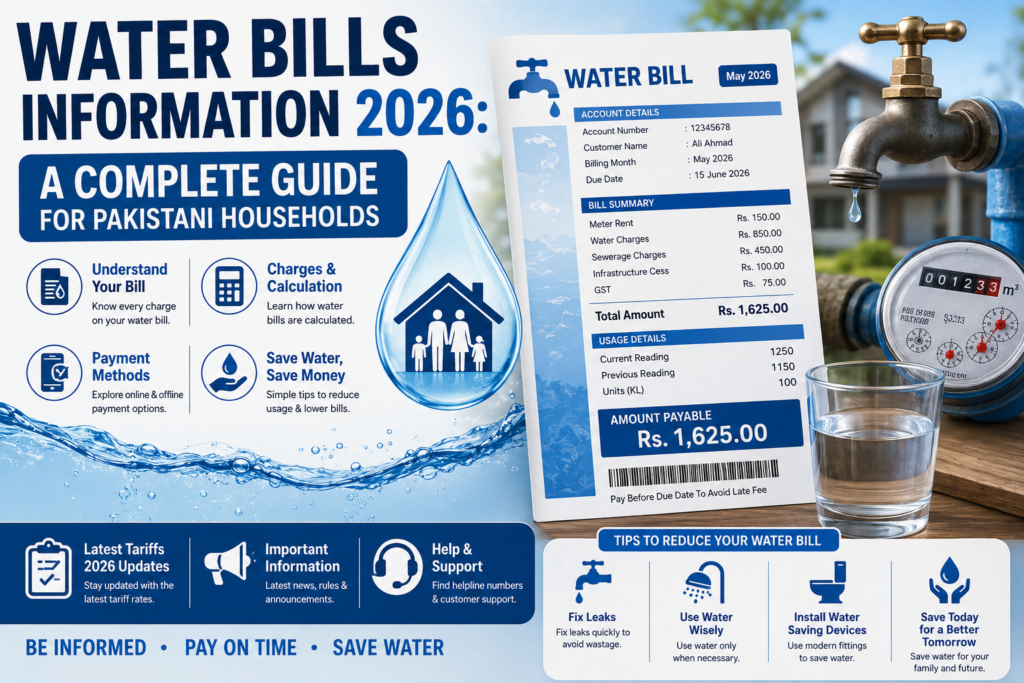
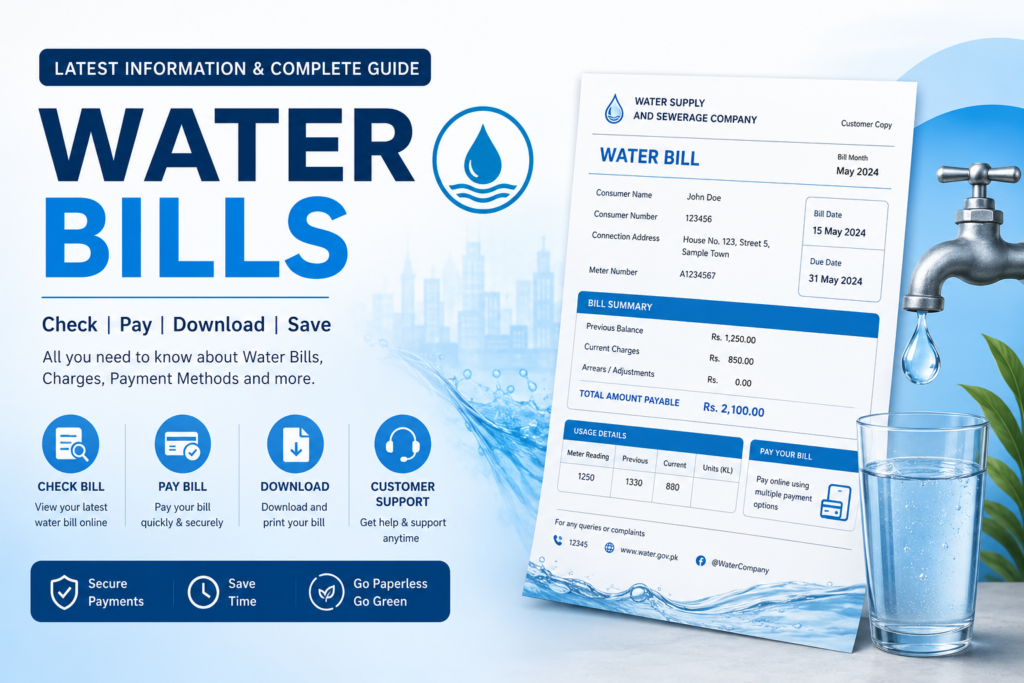
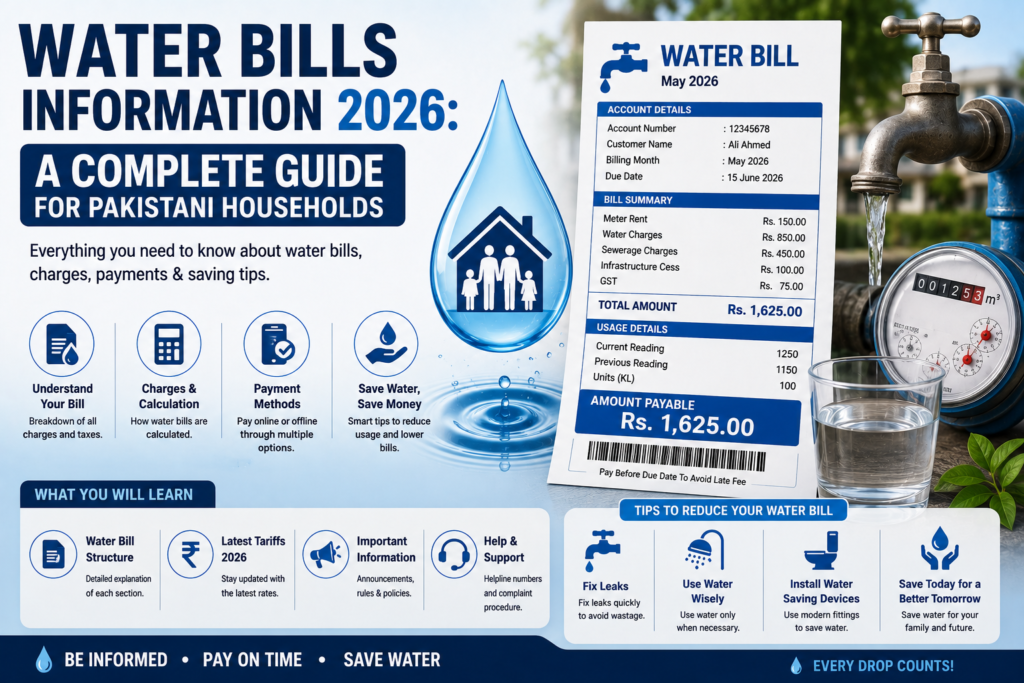
If you look closely at a printed WASA bill, it is rarely just a single “water fee.” Most bills break down into several distinct components: Water Bills Information 2026

Water rate. This is the core charge for the clean water delivered to your property. On a metered connection, it’s charged per unit of consumption (commonly per cubic meter or per gallon), and it typically increases in slabs — the more you use, the higher the rate per additional unit becomes. On an unmetered connection, this becomes a fixed monthly or quarterly charge based on the size of the property, expressed in marlas or kanals. Water Bills Information 2026

Sewerage surcharge. This is the part that catches most people off guard. Even if a household barely uses WASA’s supplied water — perhaps relying partly on a private borewell — it can still be charged a sewerage fee simply for being connected to the public drainage and sewer network. This surcharge is usually calculated as a percentage of the water charges, commonly in the range of 15–20%, rather than being a separate flat fee. Water Bills Information 2026

Fixed charges. A baseline service charge applied regardless of consumption, meant to cover administrative and infrastructure costs. This is generally higher for commercial connections than for domestic ones, and varies by city. Water Bills Information 2026
Water Bills Information 2026

General Sales Tax (GST). Typically applied at 16% on the combined total of the water charges, fixed charges, and sewerage surcharge.

Late payment surcharge and arrears. If a previous bill went unpaid, most WASA branches add a flat penalty — commonly around 10% — on top of the original arrears, which then gets folded into the current bill.

For commercial and industrial connections, tariffs are set noticeably higher than domestic rates. In several cities, commercial water charges run close to double the domestic rate for the same consumption, and fixed charges for commercial properties are often set higher as well — meaning a small shop can end up paying more than twice as much as a household using a comparable amount of water.

Metered vs. Unmetered Connections

This distinction matters more in Pakistan’s water billing system than in almost any other utility, because it fundamentally changes how your bill is calculated.

Metered connections are billed strictly on actual consumption. If your property has a functioning water meter, you can estimate your own usage between bills by noting the current reading and subtracting the previous reading — the difference tells you how many units you’ve consumed since the last billing cycle. Consumption is usually billed in increasing slabs, so higher usage months don’t just cost proportionally more, they cost progressively more per unit as well.

Unmetered connections are billed a flat rate tied entirely to the size of the property — for example, a fixed monthly charge for a 5-marla house versus a different, higher fixed charge for a 1-kanal house. There’s no reading to take and no way to reduce the bill through lower consumption, since the charge doesn’t respond to actual usage at all.

If you’re not sure which category applies to your property, the fastest way to check is to look at a recent bill: a metered bill will show a “units consumed” or reading-based figure, while an unmetered bill will simply show a flat charge tied to your property category.

City-by-City Breakdown of Water Billing in 2026

Lahore (WASA Lahore). The largest WASA operation in the country, covering roughly 350 square kilometers across eight administrative towns, including Gulberg, Model Town, Johar Town, DHA, and Allama Iqbal Town. Lahore’s domestic tariffs saw a substantial revision in recent years, and the city continues to use a mix of metered and unmetered billing depending on the area and property type.

Rawalpindi (WASA Rawalpindi). Operates independently from WASA Lahore, with its own consumer code system and billing office. Bills here typically use an 8-digit consumer code for online lookups.

Faisalabad (WASA Faisalabad). Serves Faisalabad and its surrounding areas, with its own tariff notifications separate from Lahore or Rawalpindi.

Multan (WASA Multan). Covers the Multan division, again with its own independent billing structure.

Gujranwala (WASA Gujranwala). A smaller operation relative to Lahore or Faisalabad, but structured the same way — domestic, commercial, and industrial tariff categories, with sewerage and fixed charges layered on top of the base water rate.

Karachi (KWSC). Rather than a WASA office, Karachi’s water and sewerage billing runs through the Karachi Water & Sewerage Corporation. The billing structure follows a similar logic — water charges, sewerage, and fixed fees — but tariff notifications, consumer ID formats, and payment portals are entirely separate from the Punjab WASA system.

Islamabad (CDA). Water and allied charges for the capital are billed by the Capital Development Authority rather than a WASA branch, with its own tariff schedule and online bill-check system.

Other cities. Smaller cities and towns may fall under a regional WASA office or a municipal committee handling water supply directly, depending on the province. If your city isn’t listed above, searching for “[your city] WASA” or checking with your local development authority is the fastest way to identify the right billing body.

How to Check Your Water Bill Online

Checking a WASA-style bill online has become considerably easier over the past couple of years, though the exact steps still vary a little by city.

Step 1: Identify your city’s official portal. Since there’s no single national water billing website, search specifically for your city’s name along with “WASA online bill” — for example, “WASA Lahore online bill” or “KWSC online bill Karachi.”

Step 2: Confirm you’re on the official site. A number of look-alike or third-party websites exist that mimic official portals. It’s worth checking the domain carefully, especially before entering any personal information, and sticking to recognized government domains (such as those ending in .gov.pk or .punjab.gov.pk) where possible.

Step 3: Locate the “Online Bill,” “Duplicate Bill,” or “Customer Login” section. Most portals have this clearly labeled on the homepage or under a “Billing” menu.

Step 4: Enter your Consumer Number, Account Number, or Reference Number. This is typically an 8 to 14-digit code depending on the city, and it can be found on any previous bill or on your original connection paperwork.

Step 5: View and download your bill. Once loaded, most portals allow the bill to be downloaded as a PDF, which is useful both for payment and for keeping a record.

If you’ve lost your reference number entirely and can’t find an old bill, contacting your local WASA office directly with your property address is usually the quickest way to retrieve it.

How to Pay Your Water Bill

Once you have your bill amount and reference number, there are several ways to actually pay it:

  • Mobile wallets such as JazzCash and Easypaisa, both of which support most major WASA and KWSC billers.
  • Internet and mobile banking apps, where water bills are usually listed among supported utility payments.
  • Bank branches and select ATMs, which accept water bill payments over the counter or through the machine.
  • NADRA e-Sahulat centers and authorized retail franchise outlets, useful for those without a bank account or mobile wallet.
  • Pakistan Post offices, which still accept utility bill payments in many areas.
  • WASA collection centers or head offices directly, for those who prefer to pay in person with cash or a cheque.

Because most WASA billing cycles are quarterly, it’s easy to lose track between payments. Saving your consumer number somewhere easily accessible — a notes app, a photo of an old bill, or a household folder — and setting a reminder a few days before each quarter’s due date is a simple habit that avoids a lot of unnecessary stress later.

What Happens If You Miss a Payment

Missing a due date on a water bill isn’t usually as immediately disruptive as missing an electricity bill, since water disconnections tend to be slower and less common. That said, there are real costs to letting a bill lapse:

  • Arrears carry forward. The unpaid amount is added directly to your next bill rather than being written off or handled separately.
  • A late payment surcharge is applied, commonly a flat percentage — often around 10% — on top of the arrears.
  • Repeated non-payment can eventually lead to disconnection, though this typically happens only after multiple missed cycles and prior notice, rather than immediately after a single missed due date.

If arrears do build up, it’s worth contacting the local WASA office directly rather than letting the balance grow further, since some offices offer installment arrangements for larger outstanding amounts.

How to Dispute an Incorrect Bill

If a bill looks unusually high — particularly on a metered connection — there are a few concrete steps worth taking before assuming it’s correct:

  1. Compare against your own reading. If you’ve been tracking your meter, check whether the billed consumption roughly matches what you recorded.
  2. Request a meter test. Most WASA offices allow consumers to formally request a meter inspection. If the meter is found to have an error beyond an acceptable margin (commonly cited as around 5%), the bill is typically adjusted accordingly.
  3. Check for a stuck or faulty meter. A meter that continues to register usage even when no water is being drawn is a common — and often overlooked — cause of inflated bills.
  4. Ask about low pressure or no-water complaints separately. If the issue is more about poor supply than an incorrect bill, a connection inspection can sometimes reveal a partially closed valve or a supply-side fault rather than a billing error.
  5. Keep all correspondence and reference numbers related to the dispute, in case the resolution takes more than one visit or call.

Practical Tips to Reduce Your Water Bill

Because fixed charges and sewerage surcharges apply regardless of how much water you actually use, the real savings usually come from reducing consumption on metered connections — and even unmetered households benefit from lower usage in terms of Pakistan’s broader water stress, even if it doesn’t show up directly on the bill.

  • Install an auto-float switch (liquid level controller) on your overhead tank motor. A huge amount of water is wasted every day simply because tanks overflow while a motor keeps running unattended. A basic auto-float switch shuts the motor off automatically once the tank is full, which stops both the waste and the unnecessary cost.
  • Check for silent leaks regularly. A dripping tap or a leaking toilet flush valve rarely looks like a big deal in the moment, but left unaddressed for a month, it can waste a genuinely large volume of water — and on a metered connection, that shows up directly in the next bill.
  • Track your consumption pattern if you’re metered. Noting your reading every few weeks, rather than only at bill time, makes it much easier to catch an unusual spike early rather than discovering it three months later.
  • Fix outdoor taps and hose connections, which are a common and easily overlooked source of slow, ongoing water loss.
  • Consider water-efficient fixtures where practical, particularly for high-usage points like flush systems and kitchen taps, since these tend to account for a disproportionate share of daily household consumption.

Beyond the financial angle, it’s worth remembering that groundwater levels in several major Pakistani cities are dropping at a concerning rate. Reducing water waste isn’t just about a lower bill — it’s also a small but genuine contribution to easing pressure on a resource that’s becoming scarcer.

Water Bills vs. Electricity and Gas Bills

It’s worth briefly comparing water billing to the other major utilities, since the contrast explains a lot of the confusion consumers feel.

Electricity billing in Pakistan, handled by DISCOs like LESCO, FESCO, IESCO, and others, is regulated centrally by NEPRA, uses a largely standardized tariff structure across the country, and is billed monthly with well-established online bill-check tools. Gas billing, through SNGPL and SSGC, follows a broadly similar national structure.

Water billing has none of that centralization. Each WASA sets its own tariffs, on its own schedule, using its own consumer ID format, with quarterly rather than monthly cycles, and with a much larger share of unmetered connections. That’s a big part of why so many consumers who feel comfortable navigating their electricity bill still find their water bill confusing — the underlying system is simply less standardized.

Frequently Asked Questions

Is water billing the same across all Pakistani cities?

No. Each WASA branch, along with KWSC in Karachi and the CDA in Islamabad, sets its own tariff structure, consumer ID format, and billing cycle, so rates and charges differ meaningfully from city to city.

How often are water bills issued?

Most WASA branches bill quarterly (every three months) rather than monthly, though this can vary slightly depending on the connection type and city.

What if I don’t have a water meter?

Unmetered connections are billed a flat rate based on property size rather than actual usage, so there’s no reading to submit — the charge stays the same each billing cycle regardless of consumption.

Why is my sewerage charge so high even though I don’t use much water?

Sewerage charges are usually calculated as a percentage of your water charges, but the connection itself is billed simply for being linked to the public drainage network, regardless of how much water you actually draw from the supply.

Can I dispute an unusually high bill?

Yes. You can formally request a meter inspection or test through your local WASA office. If a significant reading error is confirmed, the bill is corrected accordingly.

Are commercial water rates really higher than domestic rates?

Yes, in most cities commercial tariffs are set noticeably higher than domestic rates for comparable consumption, and fixed charges for commercial connections are also typically higher.

What’s the fastest way to pay a water bill without visiting an office?

Mobile wallets like JazzCash and Easypaisa, along with most banking apps, support water bill payments directly using your consumer or reference number.

Does WASA offer any subsidy or discount for low-consumption households?

In some cities, very low-consumption metered households may qualify for a reduced rate or a fixed-charge waiver, though this varies by location and isn’t automatic — it’s worth checking directly with your local WASA office.

Final Thoughts

Water bills in Pakistan are no longer the background utility they used to be. With recent tariff increases across Punjab and other provinces, they now represent a real and growing share of monthly household costs — and the fragmented, city-by-city nature of the billing system makes them genuinely harder to understand than electricity or gas.

Getting comfortable with a few basics goes a long way: knowing whether your connection is metered or unmetered, understanding what each line item on your bill actually represents, checking and paying online through official channels rather than unfamiliar third-party sites, and following up promptly if a bill looks wrong. And for households on metered connections, small, low-cost fixes — an auto-float switch, a repaired leak, a bit of regular monitoring — can add up to a meaningful difference over a year of billing cycles, both for the household budget and for a water supply that many Pakistani cities can increasingly less afford to waste.

Leave a Comment

Your email address will not be published. Required fields are marked *

Scroll to Top