Official Pakistan Energy Tariff Audit
NEPRA Protected Slab Rules 2026: 200-Unit Limit, 6-Month Consecutive Rule & Overbilling Rights
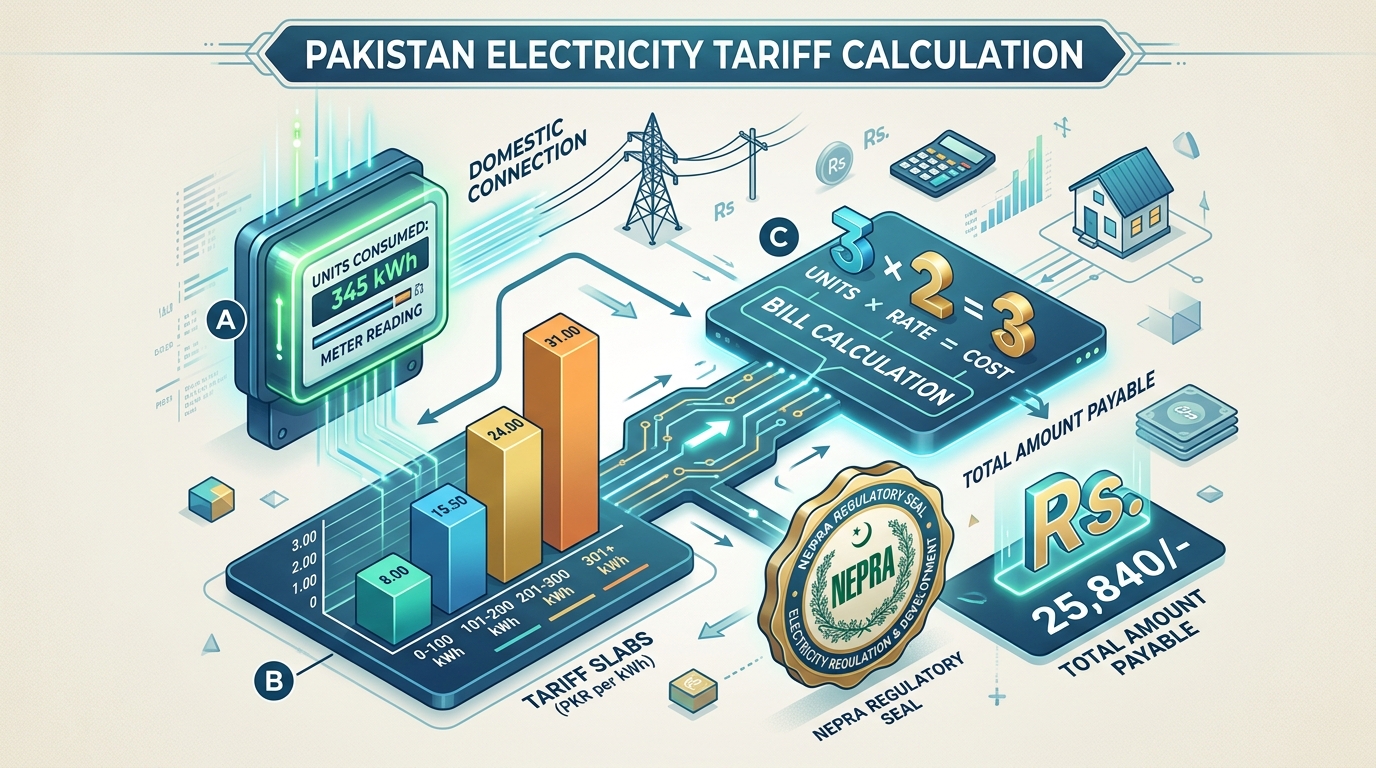
1. The 2026 Pakistan Power Tariff Architecture: SRO Directives & NEPRA Guidelines
The pricing of domestic electricity in Pakistan is determined by the National Electric Power Regulatory Authority (NEPRA) under the Regulation of Generation, Transmission and Distribution of Electric Power Act (Act XL of 1997). Statutory Regulatory Orders (SROs) promulgated by the Ministry of Energy (Power Division) enforce these uniform multi-tiered tariffs across all state-owned distribution companies—including LESCO (Lahore), MEPCO (Multan), IESCO (Islamabad/Rawalpindi), FESCO (Faisalabad), GEPCO (Gujranwala), PESCO (Peshawar), HESCO (Hyderabad), SEPCO (Sukkur), QESCO (Quetta), and K-Electric (Karachi).
Historically, domestic consumers paid progressive slab rates where early blocks (1–100 units) remained permanently subsidized regardless of total consumption. However, under sovereign power sector stabilization mandates, the government created a definitive bifurcation: consumers consuming ≤ 200 units per month are classified as Protected and receive targeted sovereign subsidies, whereas households crossing that boundary enter the Unprotected tariff schedule where all subsidies are instantly stripped.
2. Demystifying the Strict 6-Month Consecutive Rule
The single most misunderstood regulation among Pakistani consumers is the qualifying criterion for protected consumer classification. Under NEPRA rules:
The Statutory Definition of a Protected Consumer:
A domestic residential consumer (Tariff A-1a) is legally classified as Protected if, and only if, their recorded electrical consumption has remained at or below 200 kilowatt-hours (kWh) per month continuously for the preceding six consecutive billing cycles.
To illustrate the harsh mathematical reality of this administrative cliff, consider the following real-world scenario:
- January: 180 units (Protected ≤ 200) ✓
- February: 175 units (Protected ≤ 200) ✓
- March: 190 units (Protected ≤ 200) ✓
- April: 195 units (Protected ≤ 200) ✓
- May: 188 units (Protected ≤ 200) ✓
- June: 204 units (Exceeded by just 4 units!) ✗
In July, even if this household immediately cuts power consumption back down to 140 units, they will be billed under the Unprotected Domestic Schedule for July, August, September, October, November, and December! Because the consecutive six-month chain was broken in June, the consumer must complete another uninterrupted six-month run under 200 units before the billing computer automatically restores protected rates on month seven.
3. Side-by-Side Tariff Comparison: Protected vs Unprotected Unit Rates
The following analytical comparison table details the profound price differential between subsidized protected slabs and non-subsidized unprotected brackets:
| Domestic Consumption Bracket | Protected Base Rate (Rs./kWh) | Unprotected Base Rate (Rs./kWh) | Financial Discrepancy (% Increase) | 18% GST Applicable? |
|---|---|---|---|---|
| 1 to 50 Units (Lifeline) | Rs. 3.95 per kWh | Not Applicable | Heavily Subsidized Lifeline | Exempt (0% GST) |
| 1 to 100 Units | Rs. 7.74 per kWh | Rs. 16.48 per kWh | +Rs. 8.74 / unit (+112% higher) | Exempt on Protected; 18% on Unprotected |
| 101 to 200 Units | Rs. 10.06 per kWh | Rs. 22.95 per kWh | +Rs. 12.89 / unit (+128% higher) | Exempt on Protected; 18% on Unprotected |
| 201 to 300 Units | Disqualified | Rs. 27.14 per kWh | Direct transition to upper pricing | Mandatory 18% GST |
| 301 to 700 Units | Disqualified | Rs. 32.03 to Rs. 35.24 per kWh | Progressive non-subsidized tiers | Mandatory 18% GST + FPA Surcharges |
4. The Mathematical Shock: Why 201 Units Doubles Your Monthly Bill
Many consumers mistakenly believe that consuming 201 units simply means paying a higher rate on that single extra unit. This is incorrect. Once you cross 200 units, the entire slab architecture recalculates retroactively under unprotected brackets:
Case Study: 200 Units (Protected) vs 201 Units (Unprotected)
Scenario A: Consuming Exactly 200 Units (Protected)
- First 100 units × Rs. 7.74 = Rs. 774.00
- Next 100 units × Rs. 10.06 = Rs. 1,006.00
- Total Base Energy Cost: Rs. 1,780.00 (Zero GST)
Scenario B: Consuming Exactly 201 Units (Unprotected)
- First 100 units × Rs. 16.48 = Rs. 1,648.00
- Next 100 units × Rs. 22.95 = Rs. 2,295.00
- 201st unit × Rs. 27.14 = Rs. 27.14
- Base Energy Cost: Rs. 3,970.14
- 18% General Sales Tax (GST): +Rs. 714.62
- Total Payable: Rs. 4,684.76+
Result: A single extra unit increases your monthly utility liability by over Rs. 2,900 (+163%)!
5. The 31+ Days Billing Cycle Trap: Know Your Legal Protections
A widespread systemic grievance across Pakistani DISCOs is the artificial prolongation of meter reading cycles. Under the NEPRA Consumer Service Manual (CSM) Section 4.1, electricity distribution companies are legally bound to conduct meter readings strictly within 28 to 30 calendar days.
However, when meter reading squads delay field inspections until day 32, 33, or 34, a household that legitimately consumes 190 units over a standard 30-day period will record 212 units over 33 days! This administrative delinquency forces the consumer into unprotected status for the next six months.
Actionable Procedure to Contest Prolonged Billing Cycles:
- Examine Billing Period Dates: Review the "Reading Date" and "Previous Reading Date" printed on your bill. Calculate the exact number of days.
- Calculate Normalized Units: If the cycle exceeds 30 days, calculate your 30-day normalized consumption:
Normalized Units = (Total Recorded Units / Reading Days) × 30. - Submit SDO Rectification Petition: Visit your local Sub-Division Customer Service Center before the due date. The Sub-Divisional Officer (SDO) and Revenue Officer possess statutory jurisdiction to issue a revised manual counter-bill reflecting 30-day normalized units under NEPRA circular instructions.
- Lodge CAD Complaint: If sub-division officials refuse normalization, submit an immediate complaint to NEPRA Consumer Affairs Division at
cad@nepra.org.pkor call 0800-77777.
6. Actionable Blueprint: How to Regain Protected Status
If your connection was disqualified due to summer air-conditioning usage or reading spikes, follow this systematic conservation blueprint to reclaim protected status:
- Install BLDC Inverter Ceiling Fans: Standard induction fans consume 80W to 100W each. Modern Brushless DC (BLDC) inverter ceiling fans consume merely 30W to 35W, saving 1.2 to 1.5 kWh units daily per fan.
- Eliminate Instant Water Rods & Electric Geysers: Water immersion rods draw 2,000 watts. Use gas or solar water heaters during morning bathing peaks.
- Daily Meter Audit: Take a photo of your meter counter every evening. Divide your monthly target (200 units) by 30 days: your household must average no more than 6.5 units per 24 hours.
- Track Consecutive Qualifying Months: Once you complete six continuous billing months under 200 units, verify your seventh month's bill to confirm your tariff designation has reverted from
A-1a(02) UnprotectedtoA-1a(01) Protected.
7. Frequently Asked Questions (FAQ) - NEPRA Protected Slabs
Q1: Can a consumer having a 3-phase electricity connection qualify as Protected?
No. Under NEPRA tariff classifications, all 3-phase domestic connections are governed by Time-of-Use (TOU) tariffs. Protected subsidies are exclusively reserved for single-phase non-TOU domestic connections (Tariff A-1a).
Q2: Does solar net metering help a household stay within protected slabs?
Solar net metering requires a 3-phase bi-directional green meter. Because 3-phase connections are ineligible for protected slabs, net metering consumers are billed on TOU commercial/domestic net settlement rates rather than protected tariffs.
Q3: What should I do if my meter reading photo on the bill does not match the printed units?
Photograph your actual meter counter immediately. Visit your sub-division office before the due date. Under CSM Section 4.4, any mismatch between the printed meter image and recorded units entitles you to an immediate revised invoice without late payment surcharges.
Q4: Are commercial shops and small businesses eligible for protected electricity slabs?
No. Commercial properties fall under Tariff A-2 (Commercial), which operates on separate commercial flat and TOU schedules without domestic social welfare protections.
Estimate your upcoming bill based on active NEPRA slabs
Enter your units or meter readings into our free calculator to see protected vs unprotected calculations instantly.