NEPRA Electricity Unit Rate Today in Pakistan 2026: Official Slab Rates, Base Tariffs & Taxes Breakdown
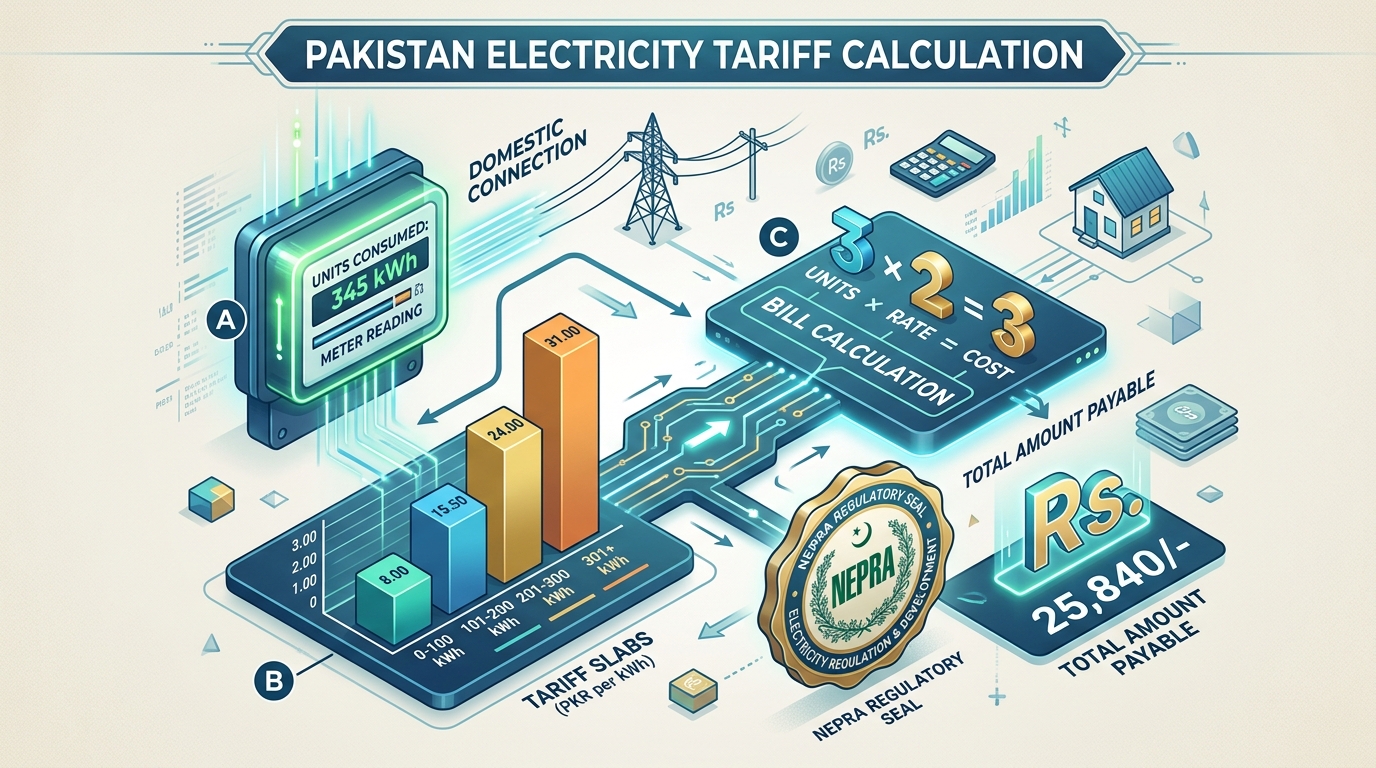
Table of Contents
- 1. 2026 NEPRA Tariff Architecture & Base Price Overview
- 2. Comprehensive Domestic Residential Slab Rates Table
- 3. Protected vs. Unprotected Consumers: The Crucial 200-Unit Threshold
- 4. Time-of-Use (TOU) Peak and Off-Peak Unit Rates
- 5. The Complete Surcharge & Tax Calculation Formula
- 6. Real-World Calculation Case Studies (150, 280, & 600 Units)
- 7. Commercial (A-2) and Industrial (B-1/B-2) Tariff Highlights
- 8. Actionable Strategies to Defend Your Protected Status
1. 2026 NEPRA Tariff Architecture & Base Price Overview
The cost of electricity in Pakistan has undergone structural recalibrations under directives from the National Electric Power Regulatory Authority (NEPRA) and the Federal Ministry of Energy. For the fiscal year 2026, the national average base electricity tariff stands between Rs. 32.50 and Rs. 35.50 per kilowatt-hour (kWh) before government surcharges, fuel adjustments, and taxes are applied. However, due to progressive slab pricing and cascading fiscal levies, the effective out-of-pocket rate paid by Pakistani households ranges from as low as Rs. 7.74 per unit for lifeline consumers up to Rs. 68.50+ per unit for heavy consumption brackets exceeding 700 monthly units.
Understanding the exact rate per unit requires dissecting the statutory components of your monthly power bill. Electricity distribution companies (DISCOs)—including LESCO, MEPCO, IESCO, FESCO, GEPCO, PESCO, HESCO, SEPCO, QESCO, TESCO, and the privatized K-Electric—do not set autonomous retail unit rates. Instead, NEPRA determines the National Uniform Tariff, which is subsequently notified by the Ministry of Energy via official Statutory Regulatory Orders (SROs). This statutory framework ensures that whether you reside in Multan, Lahore, Islamabad, or Peshawar, the baseline unit price remains uniform across the national grid.
2. Comprehensive Domestic Residential Slab Rates Table
Pakistan operates a progressive block tariff system designed theoretically to cross-subsidize low-income households using revenues extracted from higher-volume urban and industrial users. Below is the official NEPRA domestic tariff schedule (Tariff A-1 Residential) currently implemented nationwide:
| Monthly Consumption Slab | Consumer Classification | Base Energy Rate (Rs./kWh) | Effective Rate with All Taxes (Rs./kWh) | Applicable Subsidies |
|---|---|---|---|---|
| 01 – 50 Units (Lifeline) | Protected Lifeline | Rs. 3.95 | Rs. 4.25 | Full Federal Subsidy (Exempt from GST/FC) |
| 51 – 100 Units (Lifeline) | Protected Lifeline | Rs. 7.74 | Rs. 8.40 | Subsidized; TV fee exempt |
| 01 – 100 Units | Protected Non-Lifeline | Rs. 7.74 | Rs. 10.95 | Targeted cross-subsidy active |
| 101 – 200 Units | Protected Residential | Rs. 14.16 | Rs. 18.85 | Protected threshold ceiling rate |
| 01 – 100 Units | Unprotected Residential | Rs. 23.59 | Rs. 32.40 | Unprotected non-subsidized tier |
| 101 – 200 Units | Unprotected Residential | Rs. 30.07 | Rs. 42.15 | Standard non-protected bracket |
| 201 – 300 Units | Unprotected Residential | Rs. 34.26 | Rs. 48.70 | Exceeds 200 unit barrier; No slab retention |
| 301 – 400 Units | Unprotected Residential | Rs. 39.15 | Rs. 55.40 | Upper-middle residential bracket |
| 401 – 500 Units | Unprotected Residential | Rs. 41.36 | Rs. 58.80 | High volume residential load |
| 501 – 600 Units | Unprotected Residential | Rs. 42.78 | Rs. 60.95 | Heavy domestic residential load |
| 601 – 700 Units | Unprotected Residential | Rs. 43.92 | Rs. 62.60 | Heavy domestic residential load |
| Above 700 Units | Unprotected Residential | Rs. 48.84 | Rs. 68.75+ | Maximum standard tariff ceiling rate |

3. Protected vs. Unprotected Consumers: The Crucial 200-Unit Threshold
The distinction between Protected and Unprotected electricity consumers represents the single most significant factor dictating household utility expenses in Pakistan. Under NEPRA regulations, a residential domestic consumer is legally classified as Protected if and only if their monthly electricity consumption has remained under or equal to 200 units for six consecutive calendar months.
The financial consequences of losing protected status are severe. Consider the mathematical reality: a consumer consuming exactly 199 units under protected status pays a base rate of Rs. 14.16 per unit, yielding a base energy cost of approximately Rs. 2,818. If that same household consumes 201 units—just two additional kilowatt-hours—they are immediately re-designated as unprotected. In the unprotected category, the previous 200 units are no longer calculated at the protected rate; instead, the entire volume of units transitions to the higher non-protected matrix, where units between 101 and 200 jump to Rs. 30.07 per unit and the units above 200 incur Rs. 34.26 per unit.
Furthermore, once a household breaches the 200-unit ceiling even by 1 unit in a single month (for instance, during June heatwaves when air conditioning is utilized), the customer loses protected designation for a minimum of six straight months. Even if consumption drops back to 90 units in subsequent winter months, the consumer is billed under the Unprotected 1–100 slab (Rs. 23.59/unit) rather than the Protected 1–100 slab (Rs. 7.74/unit). Reclaiming protected status requires maintaining six uninterrupted billing cycles strictly below 200 units.
4. Time-of-Use (TOU) Peak and Off-Peak Unit Rates
For all domestic consumers with sanctioned loads of 5 kilowatts (kW) or higher, as well as all households equipped with 3-phase digital meters, DISCOs automatically implement Time-of-Use (TOU) dual-register metering. TOU metering eliminates progressive block slabs in favor of a bifurcated schedule consisting of Peak Hours and Off-Peak Hours.
| Season / Months | Designated Daily Peak Window | Peak Unit Rate (Base) | Off-Peak Unit Rate (Base) | Effective Peak (with Taxes) |
|---|---|---|---|---|
| Dec 1 to Feb 28 (Winter) | 5:00 PM to 9:00 PM (4 Hours) | Rs. 49.35 / kWh | Rs. 35.57 / kWh | Rs. 68.20 / kWh |
| Mar 1 to May 31 (Spring) | 6:00 PM to 10:00 PM (4 Hours) | Rs. 49.35 / kWh | Rs. 35.57 / kWh | Rs. 68.20 / kWh |
| Jun 1 to Aug 31 (Summer) | 7:00 PM to 11:00 PM (4 Hours) | Rs. 49.35 / kWh | Rs. 35.57 / kWh | Rs. 68.20 / kWh |
| Sep 1 to Nov 30 (Autumn) | 6:00 PM to 10:00 PM (4 Hours) | Rs. 49.35 / kWh | Rs. 35.57 / kWh | Rs. 68.20 / kWh |
Running high-wattage inductive equipment—such as 1.5-ton inverter air conditioners, 1-horsepower water motors, automatic washing machines, or electric irons—during the 4-hour daily peak window results in unit costs approaching Rs. 70 per kWh. Shifting non-essential household power activities to daytime or late-night off-peak hours generates immediate 30% to 45% reductions on 3-phase electricity bills without altering overall lifestyle comfort.
5. The Complete Surcharge & Tax Calculation Formula
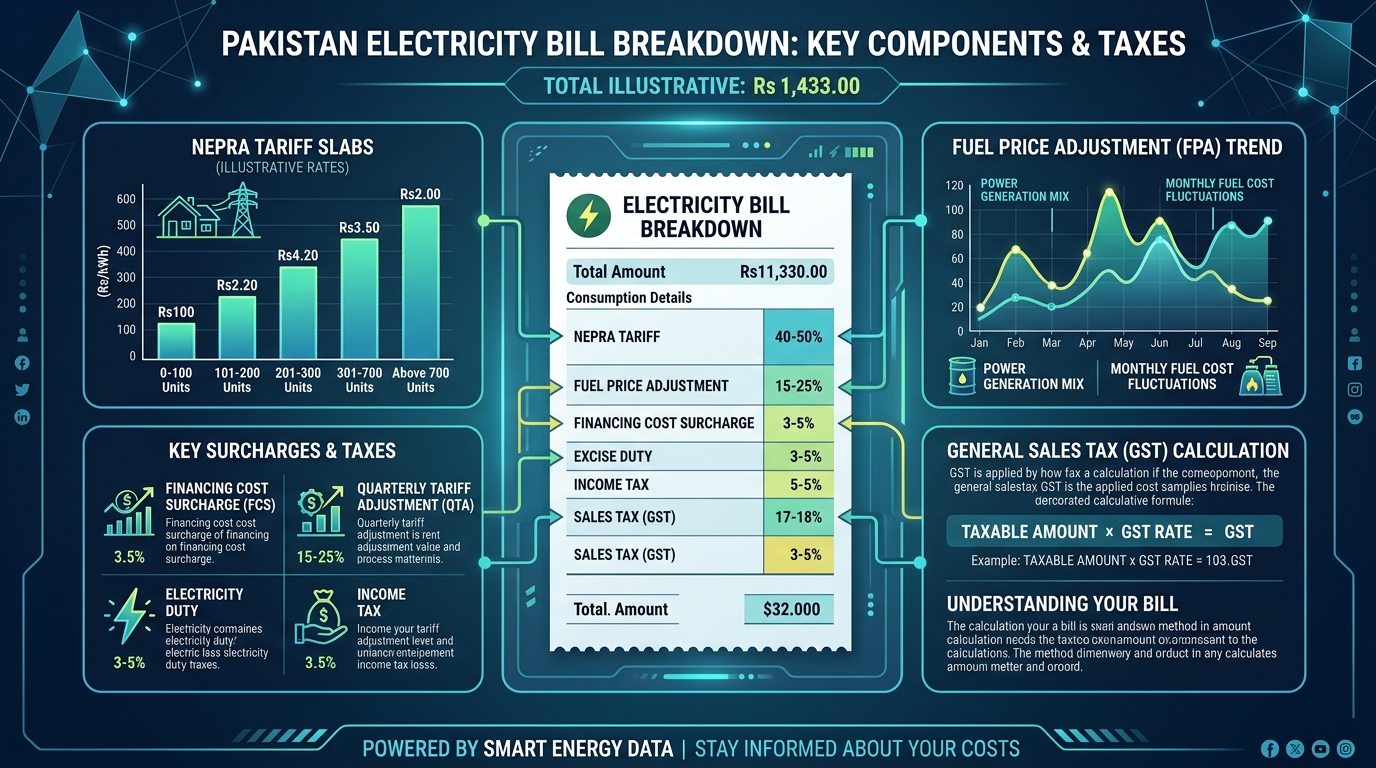
Many consumers are bewildered when dividing their total bill payable by the total units consumed, discovering that the effective rate is substantially higher than the tariff slab printed on their bill. This disparity arises because the variable energy charge is merely the starting line for eight separate statutory taxes and surcharges:
- Financing Cost (FC) Surcharge: Imposed nationally at a flat rate of Rs. 3.23 per kWh on all units consumed (excluding lifeline brackets). This levy services circular debt accumulated by sovereign energy guarantees.
- Fuel Price Adjustment (FPA): Monthly variable surcharge reflecting actual generation fuel costs incurred by the Central Power Purchasing Agency (CPPA-G) versus base estimates. In summer 2026, FPA fluctuates between Rs. 1.80 and Rs. 4.90 per unit.
- Quarterly Tariff Adjustment (QTA): Determined every three months by NEPRA to adjust for capacity payments, exchange rate fluctuations, and inflation; currently adding Rs. 1.25 to Rs. 2.75 per unit.
- General Sales Tax (GST - 18%): Assessed under the Sales Tax Act 1990 at 18% on the gross total of (Energy Charges + FC Surcharge + FPA + QTA + Meter Rent).
- Electricity Duty (ED): Provincial government tax levied at 1.5% of total variable energy charges across Punjab, Sindh, Khyber Pakhtunkhwa, and Balochistan.
- Further Tax & Extra Tax: Applied exclusively to commercial or unregistered non-filer meters without registered Sales Tax Registration Numbers (STRN).
- Income Tax (Advance Withholding - Section 235): Applied to domestic residential consumers whose monthly bill exceeds Rs. 25,000 at a rate of 7.5% if the consumer is an unverified income tax non-filer on the FBR Active Taxpayers List (ATL).
- PTV License Fee: Mandatory fixed statutory levy of Rs. 35.00 per month applied to all residential connections.
6. Real-World Calculation Case Studies (150, 280, & 600 Units)
To demonstrate how these rates operate in practice, let us examine three realistic consumer billing calculations under official 2026 tariffs:
Case Study A: 150 Units (Protected Consumer)
A modest household maintaining protected status with 150 units consumed during an autumn month:
- Units 1 to 100: 100 units × Rs. 7.74 = Rs. 774.00
- Units 101 to 150: 50 units × Rs. 14.16 = Rs. 708.00
- Total Variable Base Energy Cost: Rs. 1,482.00
- FC Surcharge: 150 × Rs. 3.23 = Rs. 484.50
- FPA Estimation: 150 × Rs. 2.10 = Rs. 315.00
- Subtotal before GST: Rs. 2,281.50
- GST (18% on Subtotal): Rs. 410.67
- Electricity Duty (1.5% on Base): Rs. 22.23
- PTV Fee: Rs. 35.00
- Total Amount Payable within Due Date: Rs. 2,749.00 (Effective Rate: ~Rs. 18.32/unit)
Case Study B: 280 Units (Unprotected Consumer)
A typical 2-bedroom urban household utilizing one inverter AC sparingly during warm evenings:
- Units 1 to 100: 100 units × Rs. 23.59 = Rs. 2,359.00
- Units 101 to 200: 100 units × Rs. 30.07 = Rs. 3,007.00
- Units 201 to 280: 80 units × Rs. 34.26 = Rs. 2,740.80
- Total Variable Base Energy Cost: Rs. 8,106.80
- FC Surcharge: 280 × Rs. 3.23 = Rs. 904.40
- FPA Estimation: 280 × Rs. 2.50 = Rs. 700.00
- QTA Estimation: 280 × Rs. 1.75 = Rs. 490.00
- Subtotal before GST: Rs. 10,201.20
- GST (18%): Rs. 1,836.21
- Electricity Duty (1.5%): Rs. 121.60
- PTV Fee: Rs. 35.00
- Total Amount Payable within Due Date: Rs. 12,194.00 (Effective Rate: ~Rs. 43.55/unit)
Case Study C: 600 Units (Upper Residential Tier)
A family house running multiple inverter ACs, deep freezer, and water pump:
- Units 1 to 100: Rs. 2,359.00
- Units 101 to 200: Rs. 3,007.00
- Units 201 to 300: Rs. 3,426.00
- Units 301 to 400: Rs. 3,915.00
- Units 401 to 500: Rs. 4,136.00
- Units 501 to 600: Rs. 4,278.00
- Total Variable Base Energy Cost: Rs. 21,121.00
- FC Surcharge: 600 × Rs. 3.23 = Rs. 1,938.00
- FPA & QTA Combined: 600 × Rs. 4.50 = Rs. 2,700.00
- Subtotal before GST: Rs. 25,759.00
- GST (18%): Rs. 4,636.62
- Advance Income Tax (7.5% for non-filer as bill exceeds Rs. 25,000): Rs. 1,931.92
- Electricity Duty & TV Fee: Rs. 351.81
- Total Amount Payable within Due Date: Rs. 32,679.00 (Effective Rate: ~Rs. 54.46/unit)
7. Commercial (A-2) and Industrial (B-1/B-2) Tariff Highlights
Electricity consumers operating retail businesses, clinics, software houses, or grocery outlets fall under Tariff A-2 Commercial. Unlike residential tariffs, commercial connections do not enjoy lifeline or progressive protected slab tiers. Commercial single-phase base tariffs average Rs. 45.80 per unit, while 3-phase commercial accounts with sanctioned loads above 5 kW are assessed fixed monthly capacity charges of Rs. 1,250 per kW of sanctioned load regardless of whether the business turns on a single light bulb.
Furthermore, commercial power connections are subjected to aggressive Advance Income Tax under Section 235 of the Income Tax Ordinance. Monthly bills above Rs. 20,000 carry mandatory advance tax withholdings between 10% and 12% for filers, escalating to punitive rates of up to 25% for unregistered commercial entities.
8. Actionable Strategies to Defend Your Protected Status
Given the dramatic cliff in unit pricing once 200 units are breached, defending your protected status is the highest-yield financial decision a middle-class household can make. Implement these tested energy conservation measures:
- Install BLDC Inverter Ceiling Fans: Traditional induction fans draw 80W to 100W, whereas modern BLDC motor fans consume only 30W to 35W. Swapping three fans running 14 hours daily saves over 75 units monthly—singlehandedly preventing a slab breach.
- Set Inverter AC Thermostats to 26°C: Lowering your AC setpoint to 18°C or 20°C forces the variable inverter compressor to operate at maximum frequency (1,800W to 2,200W). Maintaining 26°C allows the compressor to modulate down to 350W once thermal equilibrium is reached.
- Audit Water Motor Operation: A 1-horsepower pump draws 750W. Running the pump for 2 hours daily consumes 45 kWh monthly. Utilizing automatic float switches prevents water tank overflows and saves 15 to 20 units every billing cycle.
- Daily Meter Screen Auditing: Check your digital meter reading on the 20th day of your billing cycle. If you observe your cumulative kWh approaching 180 units with 7 days remaining, immediately enter conservation mode to ensure the total cutoff reading stays safely under 200 units.
Frequently Asked Questions (FAQs)
Verify Your Utility Bill Online Now
Want to check your live DISCO electricity bill or calculate your monthly cost based on your latest meter reading? Use our free, real-time tools updated with the latest 2026 NEPRA tariffs: