NEPRA Solar Net Metering Rules & Buyback Rate 2026: Export Tariffs, Green Meter Approval & NEPRA Amendments
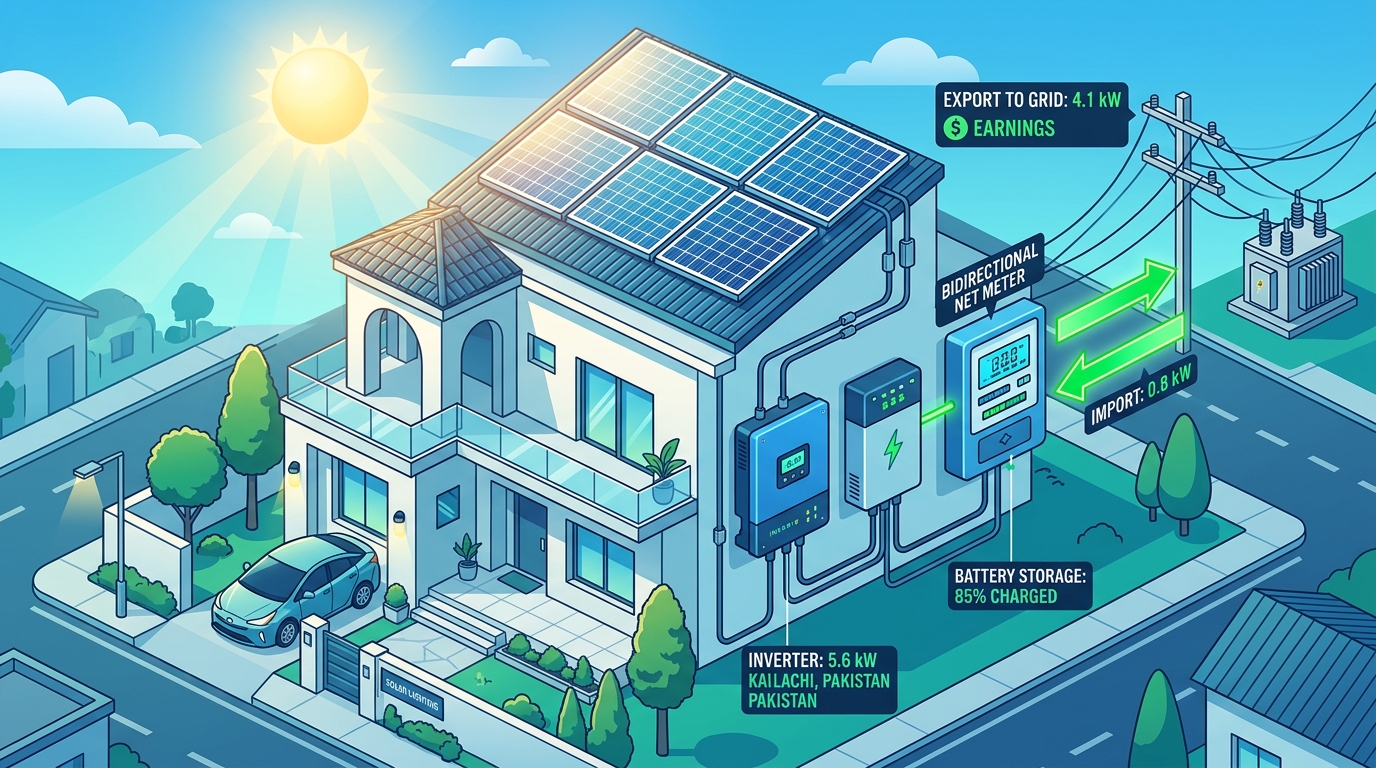
Table of Contents
- 1. 2026 Regulatory Landscape: Net Metering vs. Gross Metering Debate
- 2. Official Buyback Unit Rate: The National Average Energy Purchase Price (NEPP)
- 3. Net Metering Billing Math: Monthly 1-to-1 Offset & Quarterly Cash Settlements
- 4. Technical Standards: Inverter Certifications (IEEE 1547 & Anti-Islanding)
- 5. Step-by-Step Green Meter Approval & DISCO Sanctioning Workflow
- 6. Transformer Capacity Limitations: The 80% Feeder Quota Barrier
- 7. Financial Viability Analysis: Return on Investment under Rs. 19.32/kWh
- 8. Consumer Protection: Protecting Existing Distributed Generation Licenses
1. 2026 Regulatory Landscape: Net Metering vs. Gross Metering Debate
Distributed solar energy generation in Pakistan has reached a monumental juncture. Over the past five years, rooftop solar installations expanded at an exponential pace, with private citizens and commercial entities adding over 3,000 Megawatts of decentralized clean energy to the national grid under the NEPRA Alternative & Renewable Energy Distributed Generation and Net Metering Regulations. However, this private solar revolution has ignited intense regulatory debate between the Federal Ministry of Energy, distribution companies (DISCOs), and consumer advocacy groups.
DISCOs have argued that rapid middle- and upper-class solar adoption reduces daytime grid consumption, leaving fixed capacity payment burdens disproportionately upon lower-income non-solar households. While proposals were tabled to replace net metering with 'gross metering'--a mechanism where solar owners are forced to sell 100% of their generation at wholesale rates while buying back grid power at expensive retail prices--NEPRA has officially preserved net metering for residential consumers in 2026, safeguarding self-consumption while adjusting the export buyback tariff.
2. Official Buyback Unit Rate: The National Average Energy Purchase Price (NEPP)
A primary point of confusion among solar owners is the distinction between offset value and export buyback rate:
| Energy Flow Category | Grid Tariff Dynamic | Effective Rate (PKR / kWh) | Financial Mechanism |
|---|---|---|---|
| Daytime Self-Consumption | Offsetting Retail Grid Units | Rs. 48.00 - Rs. 68.00 | Direct reduction of high-tier bill units |
| Off-Peak Exported Units | Credited against Off-Peak Units | Rs. 35.57 / kWh | 1-to-1 unit deduction on monthly statement |
| Net Surplus Cash Buyback | National Average Energy Purchase Price | Rs. 19.32 / kWh | Quarterly monetary credit or cash bank payout |
When your solar panels generate power consumed inside your home (running air conditioners, refrigerators, and lights), you save the full retail tariff--between Rs. 48 and Rs. 68 per unit, including avoided taxes and surcharges. When surplus daytime power flows out through your bi-directional green meter, it credits your account first against off-peak units consumed during the night. Only when a household exports more total units than it consumes over an entire 3-month billing quarter does the lower Rs. 19.32 per unit buyback rate apply to cash settlements.

3. Net Metering Billing Math: Monthly 1-to-1 Offset & Quarterly Cash Settlements
Understanding how DISCO computerized billing algorithms treat net-metered connections is vital to auditing your bill. The bi-directional meter records two distinct telemetry channels: Import (kWh drawn from grid) and Export (kWh supplied to grid). Peak units are billed separately from Off-Peak units:
- Peak Units Calculation: Because residential solar does not generate power between 7:00 PM and 11:00 PM, peak hours units are recorded on Register T2. Under NEPRA regulations, daytime solar export units cannot offset peak evening units directly; peak units are billed at the standard peak rate of Rs. 49.35/unit.
- Off-Peak Units Calculation: All daytime solar energy fed into the grid is logged on Register T1. The DISCO algorithm deducts Exported Off-Peak units from Imported Off-Peak units:
Net Off-Peak Units = Imported Off-Peak − Exported Off-Peak - Negative Balance Carry-Forward: If Export exceeds Import (e.g. you imported 400 off-peak units but exported 750 units), your net billing units are zero. The remaining 350 surplus units are banked in your account and carried forward to the following month.
- Quarterly Financial Reconciliation: At the close of every billing quarter (March, June, September, December), any accumulated surplus units are liquidated by multiplying banked units by the official NEPRA buyback rate (e.g.,
1,000 units × Rs. 19.32 = Rs. 19,320). This credit is either deducted from future peak charges or disbursed directly via computerized bank payment.
4. Technical Standards: Inverter Certifications (IEEE 1547 & Anti-Islanding)
To prevent grid instability and protect utility linemen from lethal electrical back-feeding during line maintenance, NEPRA and DISCOs enforce strict grid-code compliance:
- Anti-Islanding Protection (IEC 62116 / IEEE 1547): The grid-tied inverter must feature certified automatic anti-islanding circuitry. If grid voltage or frequency collapses, the inverter must disconnect within 0.1 seconds. Inverters lacking international third-party test reports (TUV, UL, or Intertek) are rejected during DISCO commissioning.
- Total Harmonic Distortion (THD): Current harmonic distortion injected into the 11kV distribution grid must remain strictly below 3% at rated inverter output.
- Power Factor Regulation: Inverters must operate within a power factor range of 0.90 lagging to 0.90 leading to prevent reactive power penalties on commercial and 3-phase connections.
5. Step-by-Step Green Meter Approval & DISCO Sanctioning Workflow
Securing a legal net-metering connection requires navigating a standardized 7-step administrative procedure:
- Step 1: Sanctioned Load Verification & Upgrade: Under NEPRA rules, your total solar inverter capacity (kW) cannot exceed your authorized sanctioned load. If your home has a 3 kW sanctioned load and you intend to install a 10 kW system, you must first apply for an Extension of Load via
enc.com.pk. - Step 2: Selection of Pre-Qualified AEDB Installer: The EPC contractor must hold a valid Category C-1, C-2, or C-3 registration certificate from the Alternative Energy Development Board (AEDB).
- Step 3: Application Submission to SDO/XEN Office: Submit Schedule-I application along with CNIC copy, latest paid electricity bill, inverter specification sheets, and single-line electrical diagrams (SLD).
- Step 4: Distribution Transformer Loading Feasibility: The Sub-Divisional Officer (SDO) verifies that total solar capacity on your local 11kV distribution transformer does not exceed statutory limits.
- Step 5: Inspection & Form-A Verification: A licensed Electrical Inspector from the Provincial Energy Department or DISCO Meter & Testing (M&T) division inspects grounding resistance (less than 5 ohms) and verifies phase sequencing.
- Step 6: Payment of Demand Notice: The DISCO issues a computerized Demand Notice (typically Rs. 75,000 to Rs. 110,000) for the bi-directional 3-phase meter and official laboratory calibration testing.
- Step 7: Bi-Directional Meter Installation & Commercial Operation Date (COD): DISCO staff install the green meter, sign the 3-year bilateral Net Metering Agreement, and issue the final Commercial Operation Date (COD) certificate.
6. Transformer Capacity Limitations: The 80% Feeder Quota Barrier
The single most frequent cause of net metering application rejections across Pakistan is the 80% Transformer Capacity Quota Rule. Under the NEPRA Grid Code, the aggregate generation capacity of all distributed generation systems connected to a single distribution transformer cannot exceed 80% of that transformer's rated kVA capacity.
For example, on a standard 100 kVA pole-mounted transformer serving 40 residential homes, the total permissible solar generation capacity is 80 kW. If eight neighbors have already installed 10 kW solar systems each, the transformer is classified as 'Technically Saturated'. Subsequent applications are rejected until the transformer is upgraded to 200 kVA by the DISCO. Prospective solar owners should submit net-metering applications as early as possible before local neighborhood transformer quotas are exhausted.
7. Financial Viability Analysis: Return on Investment under Rs. 19.32/kWh
Despite public apprehension regarding lowered export rates, financial modeling confirms that rooftop solar remains an exceptional investment in Pakistan. Because 60% to 75% of solar power is consumed internally during daytime hours--offsetting grid power purchased at Rs. 52 to Rs. 68 per unit--the blended financial value of solar energy remains above Rs. 42 per kWh.
For a standard 10 kW system costing Rs. 1,050,000, monthly bill savings exceed Rs. 48,000. Capital payback is achieved within 20 to 24 months, providing an effective return on equity exceeding 42% per annum--vastly superior to Pakistani banking products or currency holdings.
8. Consumer Protection: Protecting Existing Distributed Generation Licenses
Under Section 21 of the Regulation of Generation, Transmission and Distribution of Electric Power Act (NEPRA Act 1997), statutory agreements signed between consumers and DISCOs enjoy contractual protection. Any potential future policy modifications regarding buyback tariffs cannot be applied retroactively to existing licensees who executed 3-year bilateral agreements under prior rules. Applying for your net-metered green meter now locks in your distributed generation rights under established legal frameworks.
Frequently Asked Questions (FAQs)
Verify Your Utility Bill Online Now
Want to check your live DISCO electricity bill or calculate your monthly cost based on your latest meter reading? Use our free, real-time tools updated with the latest 2026 NEPRA tariffs: